If attacking Iran were a business, the US just took a total bath. Military spending in the hundreds of billions. Piles of expensive missiles written off. Bases and equipment damaged.
And what did America get? Nothing. It's actually worse off than before the war. Iran now controls the Strait of Hormuz.
Trump, the businessman, is of course furious. And like any cornered CEO, he's looking for someone to blame. With midterm elections looming, he needs to distance himself from this debacle. Pinning the failure on his subordinates is pure self-preservation.
The Washington Post dropped a bombshell yesterday. At an internal meeting last week, Trump lit into Defense Secretary Hegseth, saying that he thought the ammunition shortage "had been fixed". Now he wanted answers. Why, as defense secretary, had Hegseth let him be misled?
Hegseth, feeling the heat, didn't hesitate. He pointed the finger straight at Deputy Defense Secretary Feinberg. Feinberg, he said, had failed to keep the president fully in the loop. This isn't the first time Trump has used Hegseth as
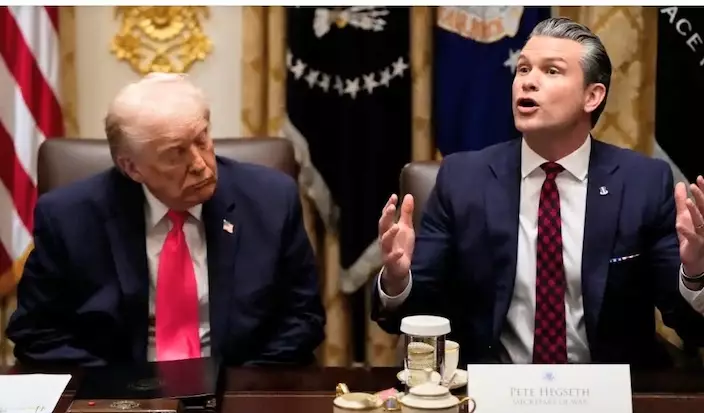
Trump threw a tantrum at an internal meeting, ripping into Defense Secretary Hegseth. His demand: explain why he was misled on the weapons shortage.
So what set Trump off? Just days earlier, he was beating the war drum, vowing even bigger airstrikes on Iran.
Then came the war council meeting. That's when the bombshell dropped. Patriot missile stockpiles? Nearly gone. Other air defense systems? Critically low. The situation was dire.
Had Iran hit back hard, US forces in the region would be sitting ducks. Trump, faced with that reality, called off the attack at the last second.
Think about that. He was making life-or-death military decisions, and he still believed the US had plenty of ammo. Unbelievable. But here's the rule in Trump's world: the boss is never wrong. He never admits a mistake.
The Washington Post describes the scene at Camp David. Trump threw a fit. He demanded Hegseth explain why he'd been kept in the dark. Why did he think the problem was solved? In Trump's mind, the fault was entirely on the other side.
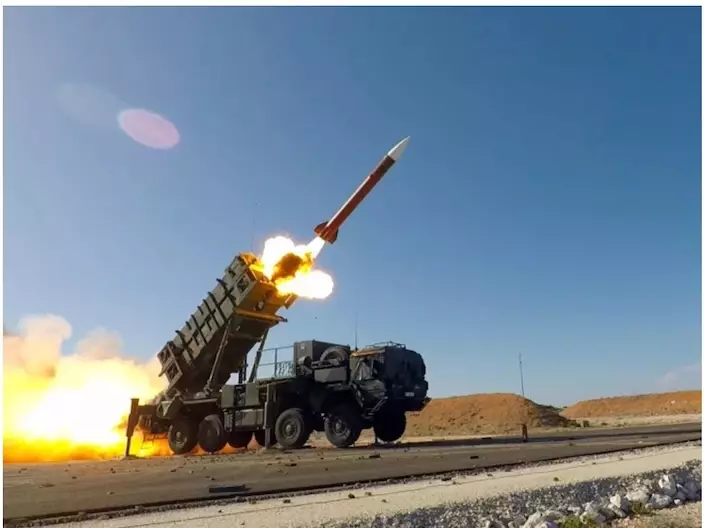
Patriot missile stockpiles are nearly depleted after the Iran strikes. The situation is dire. Trump made military decisions blind to the facts, then blamed Hegseth.
Hegseth, fresh off a brutal dressing-down, went straight into survival mode. He deflected. Deputy Defense Secretary Feinberg, he argued, was the one responsible for the weapons shortage. Feinberg had failed to make sure the president knew the real state of the ammunition stockpiles. Classic Pentagon passing-the-buck.
A History of Scapegoating and Pentagon Chaos
The two clashed at the meeting, reports say. It exposed Trump's simmering frustration with Hegseth.
Inside Trump's team, Hegseth was the top war hawk. He pushed relentlessly for war with Iran. That faction dominated the early stages of the attack. The dovish Vice President Vance only gained influence later. So Hegseth owns a bigger share of the blame for the decision to go to war.
The truth is, this wasn't new. Months earlier, in late March, with the Iran war bogged down, Trump publicly dumped the blame for starting the war right on Hegseth.
At a press conference, Trump looked directly at Hegseth, sitting beside him, and spelled it out. "Pete, I think you were the first one to speak up and you said let’s do it because you can’t let them have a nuclear weapon," Hegseth looked embarrassed, unsure how to react.
Analysts saw it coming. Trump, watching the war turn ugly, was already lining up a fall guy. Hegseth was the prime candidate.
The Pentagon was a mess under Hegseth. Political chatter had it that Army Secretary Driscoll could take his job.
But where there's smoke, there's fire. Hegseth couldn't figure out what Trump really thought. He saw Driscoll as a threat. So he moved first. He axed Driscoll's right-hand man and pushed his ally, Army Chief of Staff George, into early retirement. A loyalist of his took the spot. The Pentagon has been a snake pit of infighting ever since.
The Washington Post story dropped. White House and Pentagon spokespeople immediately denied it. Nothing like that ever happened, they said.
But let's be real: anonymous insiders who leak to the media often paint a truer picture than the official line.
The Iran attack is sputtering. And the calls for accountability will only get louder. With his absolute refusal to look weak, Trump will pass the buck however he can. Hegseth won't be the only one thrown under the bus.
Lai Ting-yiu
What Say You?
** 博客文章文責自負,不代表本公司立場 **
The world is getting more chaotic. Someone who benefits you today may hurt you tomorrow, and not just a little. The damage can be catastrophic.
The Strike and the Immediate Fallout
Amazon boss Jeff Bezos is a living example. Not long ago, he and a group of tech giants became Donald Trump's honored guests. They figured that with the president covering them, they were bound to cash in.
But then Donald Trump suddenly went to war against Iran, and Amazon took collateral damage. Its large data center in a Gulf country came under Iranian attack. The damage was severe.
Reuters reported yesterday that the center in Bahrain was almost completely destroyed. Cloud services across the entire region were paralyzed, and customers had to relocate on a large scale to other regions. Amazon suffered heavy losses, and its AI money-making plan went up in smoke.
Other tech giants had been ambitiously preparing to make big money in the Middle East. That dream has also shattered. Donald Trump truly harms people without limit.

Iran destroyed Amazon’s Bahrain cloud hubs, wrecking regional expansion plans.
The report said Amazon Web Services assessed the damage to the data center and said cloud services in the Bahrain area could no longer be repaired.
That center was one of three 'data hosting zones' the company had built in the United Arab Emirates. With one zone paralyzed, the impact already exceeded the load capacity the system was originally designed for. Operations across the whole region became difficult to maintain.
The customer base using services in the region is huge, and banking operations have taken the most direct hit. The situation is catastrophic.
According to reports, Amazon Web Services has sent notices to customers advising them to relocate operations to other regions. The company will provide assistance.
War is merciless. One attack threw the entire system into chaos. The company is suffering, customers are suffering too. The UAE government is suffering even more. They are all left in tears.
Why Iran Hit the Cloud and How Tech Giants Froze
The disaster began shortly after the US-Iran war broke out. Iran launched large-scale drone strikes on two of the three large data centers Amazon had set up in the UAE. The center in Bahrain took the heaviest damage.
The Iranian military said it targeted the data centers because the United States was using AI to formulate combat plans. Amazon's centers had provided support to US forces. That put them on the strike list.
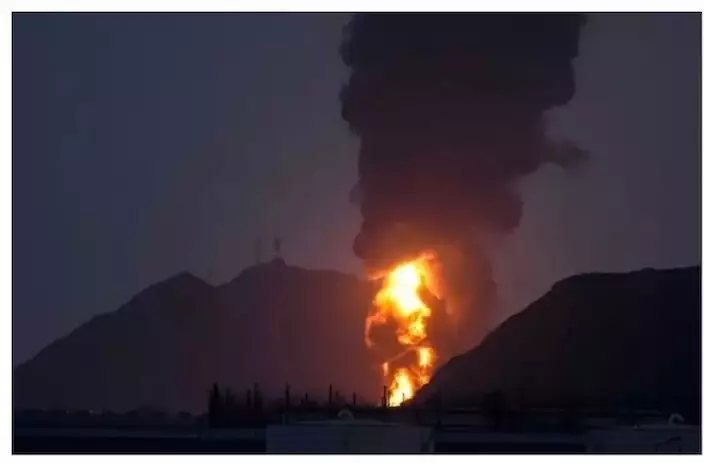
Targeted data-center airstrikes now terrify tech giants eyeing Gulf AI.
That was only the stated reason. Iran had another strategic calculation. Destroying digital infrastructure in the UAE would strike the country's economy and force it to pressure the United States to end the war as soon as possible.
The move was ruthless. Gulf states such as the United Arab Emirates, Saudi Arabia, and Qatar have been racing to transform their economies. They are investing heavily in high-tech sectors, with AI as the centerpiece, and courting American tech giants.
They knew this was a super gold mine. The giants were drooling, rubbing their hands, and ready to march in.
Amazon led the charge. Amazon Web Services quickly built three large data centers in the UAE, betting on the first taste of the broth and a fortune to follow.
At that time, OpenAI, Oracle, and Nvidia were also preparing to build mega AI campuses in the Gulf states. Shortly after Donald Trump took office, the giants accompanied him on a visit to the Middle East and signed a series of investment plans. Nvidia moved to supply its most advanced chips to AI companies in Saudi Arabia.
They all saw it as a sure-fire path to wealth.
But when the US-Israeli coalition launched its war against Iran in late February, their get-rich dreams went up in the flames of war. Iran immediately struck Amazon's large data center in the UAE and scored a direct hit, causing severe damage.
The Islamic Revolutionary Guard Corps (IRGC) then released an attack list. Amazon, Google, Microsoft, Nvidia, Oracle, and others were all named, identified as accomplices of the United States.
With the Gulf states suddenly engulfed in war and danger, the giants immediately shrank back. Every plan was frozen.
Gulf Stalls, Hong Kong Contrast
The reality is the Gulf states suffer most. Their grand plans to develop innovation, technology, and AI industries just took a heavy blow. After this data center attack, finding brave investors will be even harder.
Some US media commentaries have already drawn a blunt conclusion. The Gulf can no longer become a major AI hub, and critical technology infrastructure will not be built in the Middle East.
After reading this Reuters report, a friend immediately thought of Hong Kong's Five-Year Plan. It stresses that "Security is the prerequisite for development, whereas development reinforces security." The plan will strengthen top-level design and efficiently safeguard national security.
That naturally includes a safe business environment. If data centers were located in Hong Kong, they would be a hundred times safer than in the war-torn Gulf region.
Lai Ting-yiu