Among the items on foreign influencers' "Chinamaxxing" checklists, one phenomenon has proven particularly hard for Western commentators to digest: despite multiple rounds of US chip sanctions and tech blockades, daily smart living in China remains remarkably seamless—even ahead of the curve. Visitors hail driverless robotaxis across major cities, use AI glasses to translate street signs in real time, and multitask effortlessly on Huawei's foldable flagships—all powered by Chinese chips that were supposedly sentenced to "death."
At the 2026 Paris Motor Show, the "Smart Driving Lab" put test vehicles directly onto public streets. Out of dozens of global automakers, only two took up the challenge: America's Tesla and China's XPeng. Even Jensen Huang, who recently stepped down as Nvidia's CEO, had to admit that export controls were effectively "handing over China's roughly US$50 billion AI chip market to Huawei." This stark contrast—growing stronger under pressure—is perhaps the most dramatic chapter of the Chinamaxxing trend. To understand it, one must start with the chip that shook the tech world.
Click to Gallery
DeepSeek's models have achieved deep adaptation with domestic chips, reducing reliance on US hardware. (Illustration/Sina Finance)
Huawei unveils its Ascend 910 and 310 AI processors in Shenzhen. (Photo/Xinhua)
SMIC's 28nm mature-node chip production base. (Photo/Cnyes)
JCET's 4nm XDFOI Chiplet technology has achieved stable mass production. (Photo/IT Home)
The Huawei Mate 60 Pro features a domestic 7nm chip fabricated by SMIC. Pictured is a technician tearing down the device. (Photo/Lianhe Zaobao)
A Thunderclap: The $5.58 Million "Efficiency Revolution"
In early 2025, Chinese AI startup DeepSeek dropped a bombshell on Silicon Valley. Using just $5.576 million in raw compute costs and 2,048 export-restricted chips, its open-source model matched the performance of GPT-4o—slashing training costs by roughly 60% compared to Western peers. Nvidia's shares wobbled in response, prompting Meta CEO Mark Zuckerberg to remark that having a rival "doing better than us is always interesting." More profoundly, DeepSeek's algorithmic breakthroughs eroded Nvidia's overwhelming hardware advantage, enabling its models to run efficiently on domestic AI chips at a fraction of the cost—carving out a vital lifeline for China's supply-constrained AI sector.

DeepSeek's models have achieved deep adaptation with domestic chips, reducing reliance on US hardware. (Illustration/Sina Finance)
Market data confirms this shift is no fluke. According to IDC, Nvidia's share of China's data-center AI chip market dropped to 34% in the first half of 2026, with shipments plunging 44% year-on-year. Meanwhile, Huawei's Ascend series surged to 28%, with shipments nearly doubling to 572,000 units—narrowing the gap between the two to just 6 percentage points, down from 31 points a year earlier.

Huawei unveils its Ascend 910 and 310 AI processors in Shenzhen. (Photo/Xinhua)
A Two-Pronged Breakout: 70% of Mature-Node Orders and the "Third Pole" of Packaging
Behind this seamless user experience lies China's two-pronged semiconductor strategy. The first prong is anchoring the foundation in mature nodes. According to industry figures cited by Japan's Kyodo News, up to 70% of global orders for mature-process chips flowed to Chinese foundries between late 2025 and early 2026 (in terms of global capacity, SEMI projects mainland China will reach a 39% share by 2027). With manufacturing costs 30% to 40% lower than overseas rivals and SMIC's 28nm yield holding steady at around 98%, China has firmly secured the essential "staples" powering electric vehicles, home appliances, and industrial manufacturing.
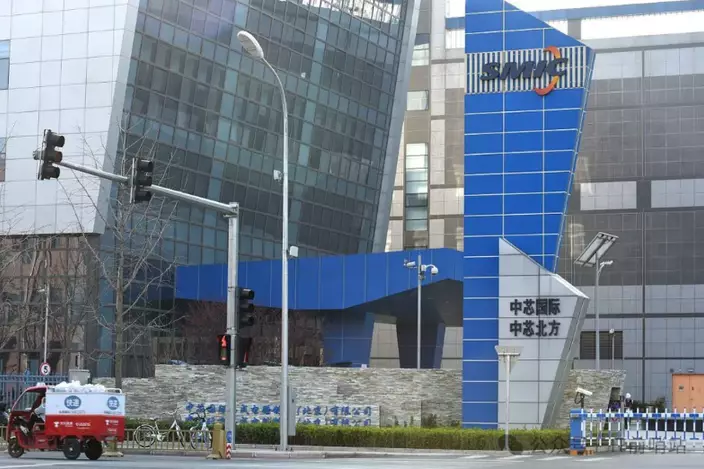
SMIC's 28nm mature-node chip production base. (Photo/Cnyes)
The second prong is pivoting toward advanced packaging. Chinese giants JCET (ranked 3rd globally), Tongfu Microelectronics (4th), and Huatian Technology (6th) together command over 20% of the global outsourced semiconductor assembly and test (OSAT) market. Tongfu has passed qualification for 3nm AMD multi-chip packaging, while JCET's 4nm XDFOI Chiplet process has entered stable mass production. Rather than forcing an entire processor onto a single monolithic die, Chinese chipmakers are fabricating smaller, specialized "chiplets" separately and assembling them like building blocks via advanced packaging. In this fastest-growing segment of the industry, Chinese firms stand among the few global players with independent, end-to-end competitiveness.

JCET's 4nm XDFOI Chiplet technology has achieved stable mass production. (Photo/IT Home)
To be sure, the broader landscape remains "strong at the mature end, vulnerable at the cutting edge"—TSMC still commands over 70% of the market for advanced nodes below 14nm. Yet Huawei's 7nm Kirin chip inside the Mate 60 demonstrated that even without extreme ultraviolet (EUV) lithography machines, Chinese engineers can push deep ultraviolet (DUV) equipment to its absolute limits. As semiconductor teardown firm TechInsights noted, the breakthrough "demonstrates the resilience of the country's chip technology capabilities" and poses "a major geopolitical challenge to countries trying to restrict its access to key manufacturing technology."

The Huawei Mate 60 Pro features a domestic 7nm chip fabricated by SMIC. Pictured is a technician tearing down the device. (Photo/Lianhe Zaobao)
National Security: The Invisible Moat
The ultimate significance of this breakout sits squarely within China's "holistic approach to national security," where semiconductors underpin three critical pillars: technological, economic, and cyber and data security. If a nation's financial system, critical infrastructure, government clouds, and data centers rest on computing power that can be severed overnight, modernization is built on sand. China's roadmap is clear: leverage a complete supply chain in mature nodes to secure the base, use advanced packaging and hardware-software co-design to outflank bottlenecks at the high end, and rally global developers through open-source ecosystems.
DeepSeek's move to open-source toolchains for Huawei Ascend—alongside an inference framework compatible with both Nvidia and Ascend—is a textbook embodiment of "you impose your blockades, we'll build our own ecosystem." According to the roadmap unveiled by Huawei Rotating Chairman Eric Xu, the next-generation Ascend 950DT is slated to debut in the fourth quarter of 2026.
Every smart experience that amazes foreign visitors is backed by a silent industrial breakout. Intended to choke off China's technological rise, the sanctions instead catalyzed the world's largest mature-node manufacturing capacity, an innovative detour via chiplets, and a generation of engineers adept at doing more with less. Technological self-reliance is no mere slogan; it is etched into the silicon of every homegrown chip—and what this invisible moat ultimately safeguards is the confidence powering the smart daily lives of 1.4 billion people.
Chinamaxxing
** 博客文章文責自負,不代表本公司立場 **
On November 9, the 31st Conference of the Parties to the UN Framework Convention on Climate Change (COP31) opened in Antalya, Türkiye. On its inaugural day, the China Pavilion shifted focus away from abstract carbon emission curves to host a dedicated side event themed "Ecological Cultural Tourism: Discovering the Beauty of China."
Li Gao, head of the Chinese delegation and Vice Minister of Ecology and Environment, articulated the core philosophy in his keynote address: ecological cultural tourism serves as the practical vehicle through which ecological values reach the broader public. "China adheres to green protection as the foundation, enriching greenery with culture, and prioritizing public benefit—relying on ecological cultural tourism to drive rural revitalization, foster local employment, and advance the value transformation that 'lucid waters and lush mountains are invaluable assets,'" Li stated, noting that these initiatives inspire citizens to appreciate natural beauty, shoulder environmental responsibility, and mobilize action for global climate governance.
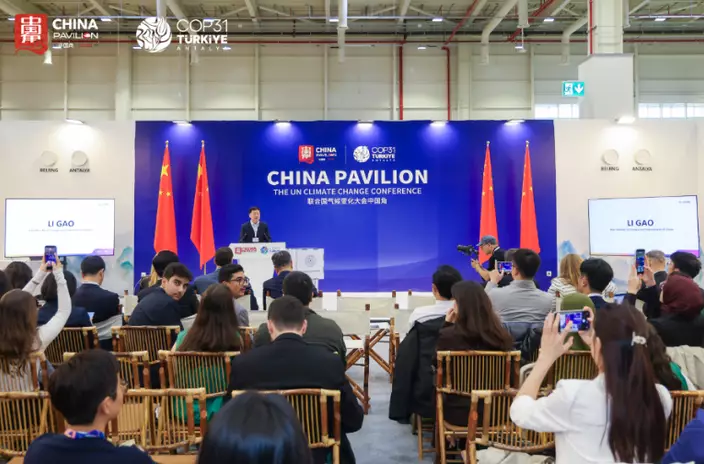
Li Gao, head of the Chinese delegation, delivers remarks at the China Pavilion during COP31 in Antalya. (Source: Official COP31 photo)
This showcase was years in the making. In May 2025, the Ministry of Ecology and Environment (MEE), alongside relevant ministries, issued the Guiding Opinions on Further Strengthening the Construction of Ecological Culture. According to Pei Xiaofei, Director-General of the MEE's Department of Education and Communications and ministry spokesperson, a nationwide call for "Discovering the Beauty of China" ecological tourism routes garnered 56 proposals across 26 provinces. Pilot programs launched on World Environment Day 2026, with the next five years focused on crafting "visible, audible, and participatory" experiences. The inaugural batch of routes will formally debut on World Environment Day 2027, supported by a carbon inclusion platform and low-carbon travel incentives. This marks the "landscapes and waters" chapter of the "Chinamaxxing" narrative—where the lenses of international visitors are becoming compelling global ambassadors for rural China.
Rural Transformation Through Foreign Lenses
People's Daily recently dedicated a special feature, "In China · Seeing China," to six photographic series captured by international residents and visitors, creating a visual chronicle of this rural transformation.
Among the most striking examples is Laomudeng, a "village in the clouds" nestled in Yunnan’s Nujiang Gorge. Framed by the Biluo Snow Mountains, traditional Nu ethnic dwellings sit veiled in mountain mist, where villagers have integrated over 3,700 mu (246 hectares) of ecological tea plantations with traditional song and dance to build a thriving sojourn tourism model. Last year, the village welcomed over 220,000 visitors, generating more than RMB 8.7 million ($1.2 million) in tourism revenue. Thwe Yee, an international student from Myanmar, reflected on the scene: "China's comprehensive rural revitalization is not merely a slogan—it is a tangible, better life within the reach of ordinary people."

Laomudeng, the "village in the clouds," featuring tiered Nu ethnic homes nestled on mist-covered slopes, captured by Myanmar student Thwe Yee. (Source: People's Daily photo)
In Yangshuo, Guangxi, the nightly Golden Dragon Parade has emerged as a viral spectacle. After dusk, 92 illuminated bamboo rafts link end-to-end to form a glowing golden dragon gliding across the Yulong River against a backdrop of karst peaks—driving steady income for family-run eateries and local artisans along the riverbanks. Russian visitor Ella Nova remarked: "Such a unique spectacle is rarely seen anywhere else; I highly recommend visiting Yangshuo to experience it firsthand."

Ninety-two illuminated bamboo rafts connect to form a glowing golden dragon gliding along the Yulong River in Yangshuo. (Source: People's Photo Network)
Meanwhile, Liangshan County in Shandong demonstrates an industrial approach to agricultural modernization. Xizhangzhuang Village established 25 cultivation bases specializing in black termite mushrooms (Oudemansiella raphanipes), producing over 50,000 metric tons of fresh mushrooms annually and transforming from an impoverished community into a village with an annual output value exceeding RMB 100 million ($13.8 million). Nigerian entrepreneur Okocha observed: "Villagers have upgraded agriculture with modern industrial thinking—preserving their connection to the land while unlocking vast commercial markets."
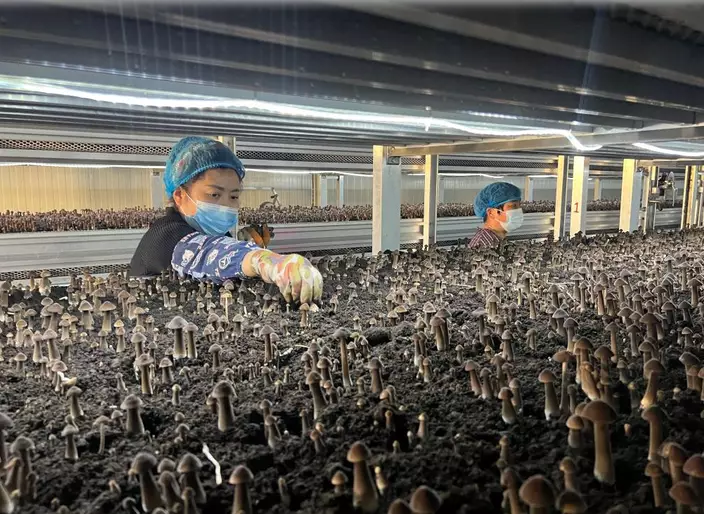
Workers harvesting fresh black termite mushrooms inside a modern cultivation facility in Shandong. (Source: Xinhua photo)
A Win-Win Blueprint for Ecology and Local Economies
The underlying formula across these cases is clear: ecological protection first, sustainable monetization second. Tangxi Village in Jiangxi Province exemplifies this through its circular "lotus-fish symbiosis" model. Nutrient-rich tailwater from aquaculture ponds, which previously risked local water pollution, is now channeled as organic fertilizer for surrounding lotus fields. A core 200-mu lotus seed base has catalyzed a 400-mu industry across two neighboring villages, generating an estimated RMB 1.6 million in annual output and turning formerly waterlogged lowlands into an ecological treasure trove. Pakistani photographer Yusafiya captured the essence of the system: "Aquaculture tailwater is no longer an environmental burden, but vital nourishment for the lotus fields."
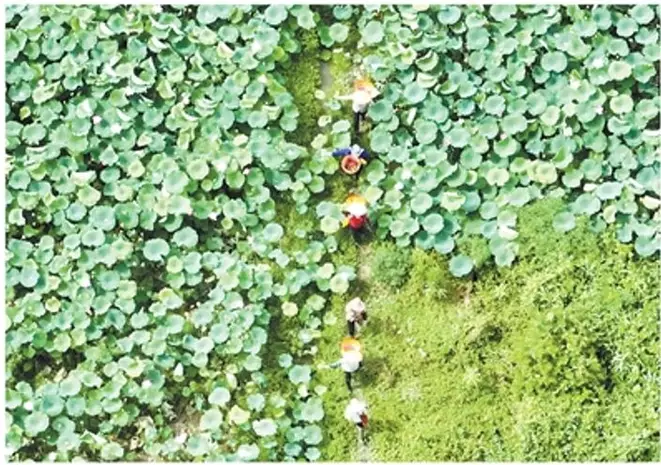
Circular "lotus-fish symbiosis" eco-farming in Tangxi Village, Jiangxi. (Source: People's Daily Online photo)
This conversion chain—turning ecological resources into developmental strengths and community prosperity—has earned international recognition. Since UN Tourism launched its "Best Tourism Villages" initiative in 2021, China has seen 15 villages inducted onto the list, ranking first globally—including Azheke Village among the Hani Rice Terraces, swan-wintering Yandunjiao Village, and Xitou Village, which boasts 92% forest coverage.
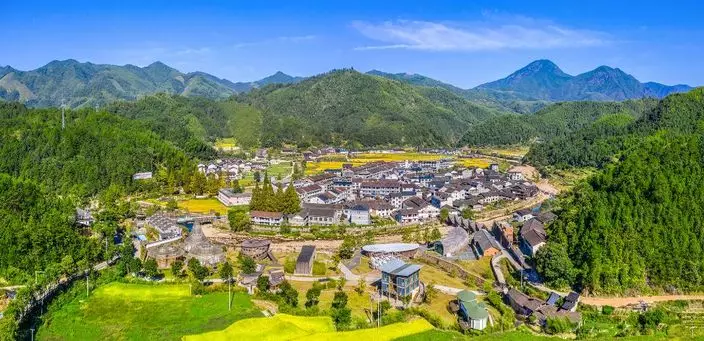
Lush green landscapes surrounding Xitou Village in Zhejiang Province. (Source: Xinhua photo)
This represents the most sustainable chapter of the "Chinamaxxing" story: international audiences are drawn to a development model that weaves environmental stewardship directly into rural prosperity. Protecting green foundations makes the golden dragon parades and cloud-top villages possible; infusing greenery with cultural heritage sustains folk-song study tours and traditional performances; prioritizing community benefit delivers 220,000 visitors and RMB 8.7 million in local income.
At the core of this framework lies ecological security. Only by upholding strict Ecological Conservation Redlines and restoring natural ecosystems does tourism revenue become a sustainable dividend of nature rather than an ecological overdraft. A nation capable of enabling rural communities to prosper continuously from lucid waters and lush mountains offers direct proof of ecological security in action. This explains why rural cultural tourism took center stage at COP31: China’s experience demonstrates that environmental conservation and economic growth need not be a zero-sum game.
Notably, the Chinese delegation at COP31 included representatives from the Hong Kong and Macao SAR governments. For residents in Hong Kong, this vision feels close to home: surrounding villages across the Greater Bay Area, along with countryside homestays and tea estates on the mainland, have already become favorite weekend retreats. On their next trip north, Hong Kong travelers serve both as visitors and firsthand witnesses to this living experiment of turning green landscapes into lasting prosperity.