Hong Kong migrants in the UK have been hit hard lately. The British government cut off much of its funding, leaving Hong Kong organizations scrambling to survive on their own. Frustration and internal clashes erupted as groups fought over the limited resources. Simon Cheng, founder of "Hongkongers in Britain," has stirred controversy by trampling over other groups in his scramble for those funds.
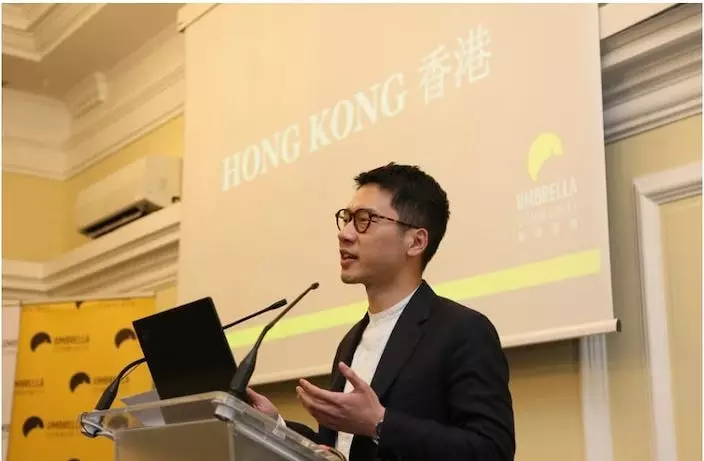
Law dumped HK exile groups and axed his faction to curry favour with British elites.
But Nathan Law, once a big name in Hong Kong activism, has taken it up a notch—he’s quietly pulled away from fellow activist groups, even dissolving his own faction, choosing to cozy up with British elites instead of charging on the front lines. Some now see him as an "undercover ally" to the establishment, reporting back on the mindset and moves of his activist peers. This shift from a big brother of the cause is bound to crack open even more internal divisions, and a split seems inevitable.
“Bonham Tree Aid” Snub
Take the “Bonham Tree Aid,” for example. This fund relies on private donations to support imprisoned Hong Kong activists and those who fled to the UK. Two years ago, it invited Nathan Law to be on its committee of finance to boost its profile. But recently, Law's appearances have become rare. Multiple invites to events saw him dodge with excuses and a frosty attitude. Some committee members are openly dissatisfied. Rumor has it that Law expressed dislike for the fund and its personnel, showing up only when he “had no choice.” On the other hand, Simon Cheng, who also serves as a committee member there, has accused Law of being more interested in his own political glory. The friction between them is now out in the open, and Law’s distancing from the fund is one clear sign of their fallout.
Disbanding Your Own Crew
Law hasn’t stopped with avoiding groups he dislikes—he even abandoned the “Hong Kong Umbrella Community” (HKUC), which he himself founded. In mid-March, he officially disbanded it by deregistering with the UK Companies House. The excuse? Operational and resource challenges, plus the strain of relying solely on volunteers as British government funding dried up. The article cited insiders revealing that the HKUC had applied for grants under the UK’s “Welcome Hong Kong People” scheme but was turned down. Observers say Law, seeing no resources left to share and having changed his game plan, decided to pull the plug and chart a new course.
Undercover Ambitions
Word is, Law privately declared he’s done with “charging at the frontlines” like other groups. Instead, he wants to court British officials and MPs, convinced street protests are a dead end and that entering the establishment is the smarter play. This “class transition” goal requires cozying up to the British elite, and Law seems ready to play his part. To do so, he reportedly cooperates closely with the British government and even acts as an “undercover ally,” turning up at protests not to protest but to gather intel on activists’ plans and moods.
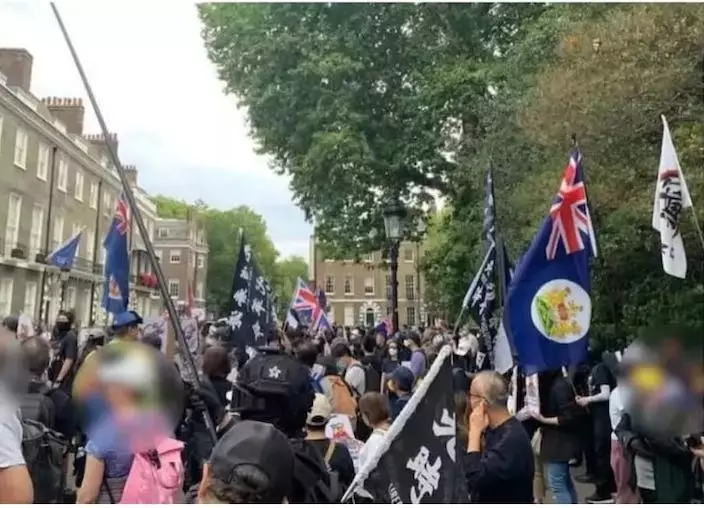
Word is, Law now pegged as a UK “undercover” spy, tailing fellow activists at protests.
This might sound surprising, but it's not new behavior. Two years ago, Law attempted to jump-start his upward climb by applying to Oxford University’s Public Policy Master’s program. He banked on a recommendation from former Hong Kong Governor Chris Patten, Oxford’s Chancellor. Unfortunately, a sexual harassment allegation—though unproven—damaged his character reference, causing his application to fail. The same scandal cost him his place in the anti-China “Hong Kong Democracy Council.” Officially, he resigned, but word on the street is he was forced out, and his standing among the activist community has since tumbled.
Because of all this, as Law distances himself from Hong Kong migrant organizations and plays the establishment game, many former supporters no longer see him as the “big brother” he once was. His influence is waning fast. With funding cuts tightening and ambitions diverging across the pro-democracy camp in exile, these internal tensions are only going to deepen. Nathan Law’s climb into the British establishment might just be the spark that blows the activist community apart.
Lai Ting-yiu
What Say You?
** The blog article is the sole responsibility of the author and does not represent the position of our company. **
The US-Iran peace talks are turning into a roller coaster. Last Friday, Iran said it would reopen the Strait of Hormuz, lifting global hopes, but Trump quickly turned up the heat by declaring that the U.S. naval blockade on Iranian ships and ports “will remain in full force”. Iran then hardened its position at once, saying it would resume control of the strait.
In the space of two days, the whole picture changed, throwing fresh turbulence into the negotiations. Earlier this week, US Marines forcibly seized an Iranian cargo ship, pushing tensions even higher and bringing a new round of conflict to the brink.
Iran and the US now look set for a head-on clash, because whoever controls the Strait of Hormuz will hold the upper hand in this struggle. Tehran sees the waterway as a long-term trump card for resisting the US and rebuilding the country, so it clings to it tightly and will not hesitate to fight another hard battle over it.
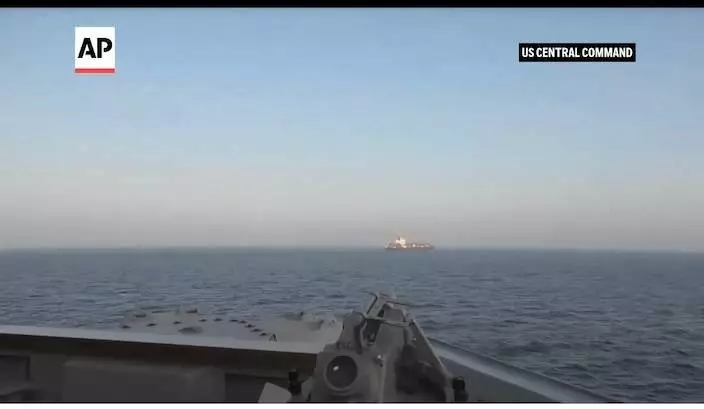
US forces are blockading the Strait of Hormuz and intercepting Iranian vessels, supercharging the fight for control. With a fresh clash looming, peace talks face a dark, uncertain future.
For Iran, the key to victory or defeat in this campaign is whether it can keep a firm grip on the strait. That is why it will not yield a single inch. This logic has already been visible in the series of moves it made after the war began. In an April 3 article examining the US-Iran war, The Wall Street Journal quoted Vali Nasr, a Johns Hopkins University professor and former senior State Department official who has crossed swords with Iranian officials. He said: “Now, the only reason why they are surviving this war is because of the strait. The Iranian thinking is that, at the end, the strait must remain under their control because it is their only deterrence and only source of revenue.”
To keep hold of this “weapon of mass destruction” over the long run, Iran has already introduced legislation in parliament. The aim is to write toll collection in the strait into law and explicitly bar non-friendly countries from passing through.
The Wall Street Journal also interviewed another senior fellow familiar with Iranian thinking, Hassan. His reading is that if Iran controls the strait, it could in future impose selective sanctions on any country and choke off shipping through the waterway at will. That would give Tehran an open-ended bargaining chip. Even if Iran suffers heavy damage in the current war, it would still retain the capacity to threaten enemy states.
That hardline strategy is clearly taking shape. In an interview with the BBC today, Ebrahim Azizi, a member of parliament and former Revolutionary Guards commander, said bluntly: “Iran's successful ‘weaponization’ of the strait is one of our key assets against the enemy.” Iran therefore intends to keep a tight hold on the power to decide which ships may pass. In other words, it wants this waterway fully under its command from now on. A scholar at the University of Tehran said the government sees the Strait of Hormuz as Iran’s main strategic lever, and that control over it is a red line that cannot be crossed.
Trump plainly sees what Iran is trying to do. He also knows that if the US loses control of the Strait of Hormuz, it will come out the loser in this war. So he panicked and rushed into a hardline response, declaring a US military blockade on ships entering and leaving Iranian ports. More, he sent Marines to board and seize an Iranian cargo ship for the first time.
But the blockade is already showing cracks because the decision was made in haste. First, US naval vessels can only carry out interceptions in international waters far from the shores of the strait, so as to avoid Iranian attack, and that makes the operation look weak. Second, the US military cannot stop Iran’s own blockade moves. The initiative over which ships may pass remains firmly in Iranian hands. For example, the US military has no effective answer if Iran lays mines in the strait.
By continuing to blockade the Strait of Hormuz, Iran can afford to sit back and wait for the enemy to tire. It is playing a long game against the US, waiting for the right moment to strike. Trump, by contrast, now has a major headache. If the strait stays closed to navigation, oil prices are bound to surge. That will hit the US economy harder and drive up political pressure on him. He originally wanted to wrap up peace talks quickly and pull himself out of the war. Now the fight over control of the strait threatens to drag the conflict out and even intensify it, making a clean exit more remote than ever.
Faced with this mess, Trump convened an emergency meeting in the White House Situation Room yesterday. He brought together Vice President Vance, Secretary of State Rubio, Secretary of Defense Hegseth and Treasury Secretary Bessent to discuss how to deal with the impasse. But finding a smart way out will be anything but easy.
Before this latest war with Iran broke out, the Strait of Hormuz had long enjoyed free passage and relative calm. But Trump misread the situation. He thought he could smash Iran with one blow, yet instead he forced a cornered adversary to fight back. That pushed Tehran to unleash its ultimate weapon by blockading the strait, and to move at the same time toward making its control permanent. It is a consequence Trump clearly did not see coming.
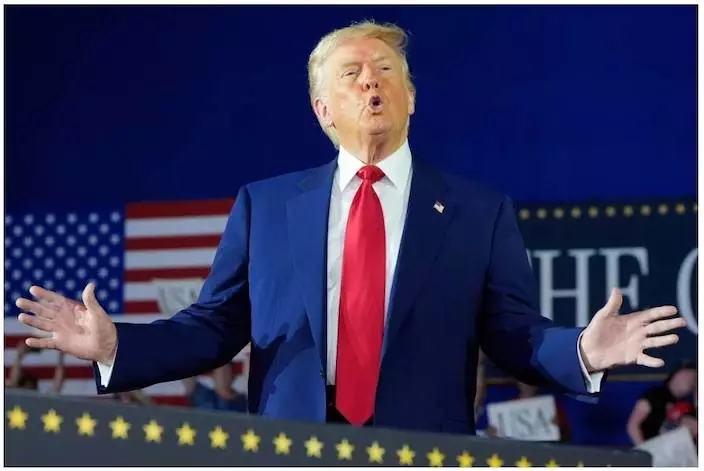
Trump’s war has pushed Iran to seize the strait and lock down permanent control. By forcing Tehran's hand, he has shot himself squarely in the foot.
Trump’s habit of shooting himself in the foot has once again produced a bitter result. Former Secretary of State Hillary Clinton recently said in a US media interview that every tabletop exercise on a US-Iran conflict during her time in office predicted Iran would blockade the Strait of Hormuz. In addition, Joint Chiefs Chairman Keane had also warned before the war began that Iran was highly likely to take that step. Yet Trump chose war on instinct and ignored the trump card in Iran’s hand. That is how he ended up trapped in today’s disorder.
The most painful part is that the deadlock over control of the strait remains unresolved, while peace talks have once again hit a roadblock. Whether the two sides can return to the table is now highly uncertain. In the meantime, the world is still being forced to pay the price for Trump’s reckless war.
Lai Ting-yiu