From Protester to Terrorist
After a grueling 159-day trial, the court handed down a guilty verdict on Thursday: Ho Cheuk-wai and two co-defendants convicted of “conspiracy to cause an explosion,” facing stiff sentences for crimes that went far beyond street clashes. Friends following these cases tell me there’s an eerie symmetry with last November’s Dragon Slayer Squad bombing conviction. Both gangs began as disillusioned protesters, then morphed into terror cells. Both recruited fellow radicals into specialist roles, obediently executing every order as if under a spell. And both engineered weapons designed to slaughter indiscriminately—truly monsters, no longer human.

In the Port Bombing Case, the three defendants were found guilty. Ho Cheuk-wai – from PolyU protester to bomb mastermind.
These stories underscore how violent demonstrations can spiral into full-blown terrorism. Had authorities not moved decisively to root out these bomb-making maniacs, the death toll could have been catastrophic.
Engineering Mass Destruction
Take Ho Cheuk-wai’s Port Bomb Gang. In court he admitted participating in the PolyU siege, even diving into drainage tunnels to rescue comrades—a clear sign of his deep-seated hatred for police and government. Under his direction, a flat in Tai Kok Tsui became a bomb factory. Police explosives experts found enough ammonium nitrate—57 kg alone—for high-yield charges and TATP, the infamous “Mother of Satan.” A single blast from these devices would have leveled buildings and killed scores within a 50-metre radius.
Meanwhile, the Dragon Slayer Squad plotted with equal cold-blooded precision. Named after their animus toward the Police Tactical Unit (“The Raptors”), members amassed large quantities of explosives, bought firearms, and even traveled to Taiwan for military training. They produced two bombs—a 2 kg device and an 8 kg behemoth with a 400-metre blast radius.
Both the Dragon Slayer Squad and the Port Bomb Gang planned their attacks meticulously aiming at massive damage on lives. According to Police’s explosive specialist Chief Superintendent Lo Bing-sin, Ho Cheuk Wai’s group planned a twin-strike at Lo Wu Station in February 2020, then an even bigger attack at Sheung Tak Shopping Centre on March 8. Only arrests averted a massacre.
While the Dragon Slayer Squad’s methodology was chillingly: vandalize shops on Hennessy Road to lure officers toward a smaller bomb, detonate it by mobile phone, then, from a nearby vantage point, shoot at first responders—herding them toward a larger device rigged to go off at the perfect moment.

Dragon-Slaying Squad’s explosives – an eerie mirror of the Port Bomb Gang’s mass-killing arsenal.
When Protest Turns to Terror
Friends who’ve studied both cases say it all stemmed from “toxic radicalism”, a toxic cycle that turned ordinary protesters into inhuman perpetrators. It’s not new: Japan’s Red Army, Germany’s Red Army Faction, America’s Weather Underground—all once-idealistic radicals who descended into terror and self-destruction.
The lesson is stark: terrorism must be stamped out at its inception. Hong Kong is fortunate its police neutralized these bomb-obsessed extremists before they could unleash havoc.
Lai Ting-yiu
What Say You?
** 博客文章文責自負,不代表本公司立場 **
Hong Kong migrants in the UK have been hit hard lately. The British government cut off much of its funding, leaving Hong Kong organizations scrambling to survive on their own. Frustration and internal clashes erupted as groups fought over the limited resources. Simon Cheng, founder of "Hongkongers in Britain," has stirred controversy by trampling over other groups in his scramble for those funds.
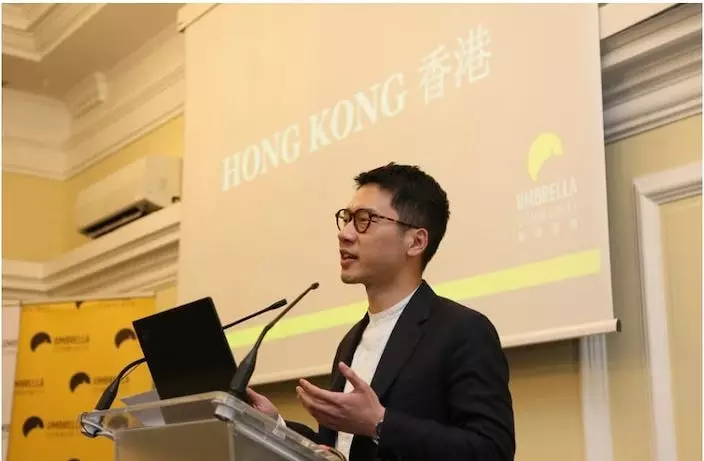
Law dumped HK exile groups and axed his faction to curry favour with British elites.
But Nathan Law, once a big name in Hong Kong activism, has taken it up a notch—he’s quietly pulled away from fellow activist groups, even dissolving his own faction, choosing to cozy up with British elites instead of charging on the front lines. Some now see him as an "undercover ally" to the establishment, reporting back on the mindset and moves of his activist peers. This shift from a big brother of the cause is bound to crack open even more internal divisions, and a split seems inevitable.
“Bonham Tree Aid” Snub
Take the “Bonham Tree Aid,” for example. This fund relies on private donations to support imprisoned Hong Kong activists and those who fled to the UK. Two years ago, it invited Nathan Law to be on its committee of finance to boost its profile. But recently, Law's appearances have become rare. Multiple invites to events saw him dodge with excuses and a frosty attitude. Some committee members are openly dissatisfied. Rumor has it that Law expressed dislike for the fund and its personnel, showing up only when he “had no choice.” On the other hand, Simon Cheng, who also serves as a committee member there, has accused Law of being more interested in his own political glory. The friction between them is now out in the open, and Law’s distancing from the fund is one clear sign of their fallout.
Disbanding Your Own Crew
Law hasn’t stopped with avoiding groups he dislikes—he even abandoned the “Hong Kong Umbrella Community” (HKUC), which he himself founded. In mid-March, he officially disbanded it by deregistering with the UK Companies House. The excuse? Operational and resource challenges, plus the strain of relying solely on volunteers as British government funding dried up. The article cited insiders revealing that the HKUC had applied for grants under the UK’s “Welcome Hong Kong People” scheme but was turned down. Observers say Law, seeing no resources left to share and having changed his game plan, decided to pull the plug and chart a new course.
Undercover Ambitions
Word is, Law privately declared he’s done with “charging at the frontlines” like other groups. Instead, he wants to court British officials and MPs, convinced street protests are a dead end and that entering the establishment is the smarter play. This “class transition” goal requires cozying up to the British elite, and Law seems ready to play his part. To do so, he reportedly cooperates closely with the British government and even acts as an “undercover ally,” turning up at protests not to protest but to gather intel on activists’ plans and moods.
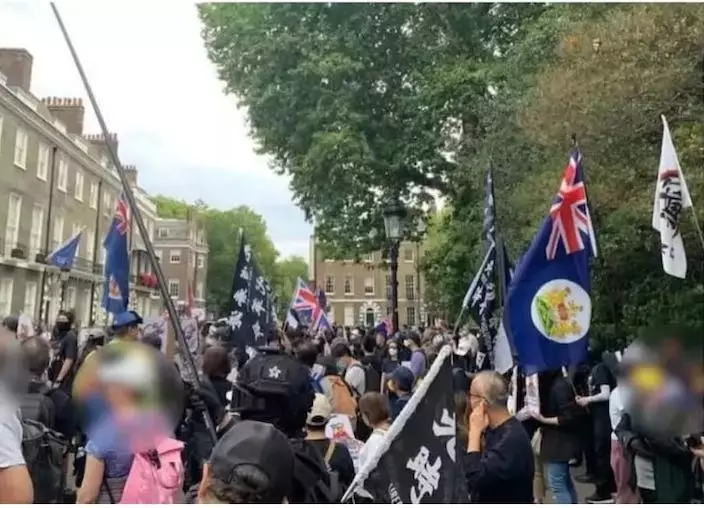
Word is, Law now pegged as a UK “undercover” spy, tailing fellow activists at protests.
This might sound surprising, but it's not new behavior. Two years ago, Law attempted to jump-start his upward climb by applying to Oxford University’s Public Policy Master’s program. He banked on a recommendation from former Hong Kong Governor Chris Patten, Oxford’s Chancellor. Unfortunately, a sexual harassment allegation—though unproven—damaged his character reference, causing his application to fail. The same scandal cost him his place in the anti-China “Hong Kong Democracy Council.” Officially, he resigned, but word on the street is he was forced out, and his standing among the activist community has since tumbled.
Because of all this, as Law distances himself from Hong Kong migrant organizations and plays the establishment game, many former supporters no longer see him as the “big brother” he once was. His influence is waning fast. With funding cuts tightening and ambitions diverging across the pro-democracy camp in exile, these internal tensions are only going to deepen. Nathan Law’s climb into the British establishment might just be the spark that blows the activist community apart.
Lai Ting-yiu