
Hong Kong people who relocated to the UK recently had a major scare when the Reform UK party proposed scrapping "permanent residency." It felt like being on a train and suddenly hearing the final station was cancelled, leaving their dream of settling in the UK shattered. Although party leader Nigel Farage later walked it back, clarifying BNO visa holders wouldn't be affected, the future of "permanent residency" remains shaky.
Now, a "yellow-camp" think tank has switched gears, dropping the moral arguments and instead "talking money." They claim that if the UK grants BNO holders permanent residency, Britain could rake in £4 billion (around HK$40 billion) in capital by 2029—a very shiny object to dangle in front of a struggling government.
A quick look reveals this think tank was set up by the wanted fugitive Dennis Kwok, with its advisory committee featuring other wanted figures like Kevin Yam and Joseph Lian. The agenda here isn't subtle. But whether a UK government already buckling under immense anti-immigration pressure will fall for this bait is another question entirely.
The Moral Card Has Expired
Until now, organizations lobbying for Hong Kong migrants in the UK have all sung the same tune, demanding the Labour government preserve the "5+1" pathway to permanent residency by playing the "moral responsibility" card. Despite the high-minded rhetoric, the government has turned a deaf ear. Why? Because it's caught in a pincer movement: politically, the anti-immigration wave is cresting, and economically, the government is practically bankrupt.
As the old saying goes, poverty dulls ambition; moral obligations are a luxury it can no longer afford.
The "yellow-camp" think tank, the China Strategic Risks Institute (CSRI), clearly gets it. Talking morals with the UK government is a dead end. So, it's changed its tack, presenting a cold, hard cost-benefit analysis: The nearly 170,000 Hong Kong people in the UK hold over HK$30 billion (about £3 billion) in their Mandatory Provident Fund (MPF) accounts. But since the Hong Kong government doesn't recognize the BNO visa as a basis for permanent departure, they can't legally touch that money.

Fugitive Dennis Kwok's 'think tank' dangles a HK$40 billion carrot. But will a cash-strapped UK bite, or is it just a desperate ploy?
The pitch is simple: if the UK government grants them permanent residency, these accounts can be unfrozen. Combine that with other funds, and the total inflow could hit nearly £4 billion by 2029.
The think tank argues that once BNO holders in the UK get their hands on this cash, most of it will be transferred to Britain and plowed into the financial and property markets. For the UK, this represents a huge, tangible benefit that could give its economy a much-needed shot in the arm.
Who's Really Pulling the Strings?
So what’s the political game here? Before we get into that, let's look at what CSRI really is.
Records show that former Civic Party lawmaker Dennis Kwok bolted from Hong Kong in November 2020 and fled to Canada (he holds Canadian citizenship). By May 2023, he popped up in London, grandly announcing the launch of the "China Strategic Risks Institute" (CSRI) in the UK Parliament.
From day one, it had already declared its focus on the global impact of China's rising "totalitarianism"—its anti-China stance couldn't be more obvious. Its advisory committee includes other wanted individuals like Kevin Yam, now in Australia, and Joseph Lian, a former director of Stand News who is also a fugitive.
With a lineup like that, it's pretty clear what their real game is.
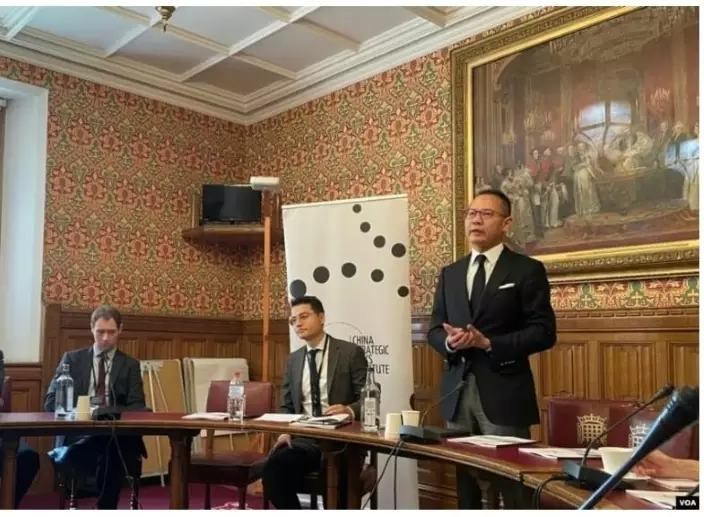
Launched in the UK Parliament, Dennis Kwok's outfit has 'anti-China' written all over it. A think tank in name, a political weapon in reality.
Furthermore, CSRI is cozy with the chaos-sowing group "Hong Kong Watch." This organization has been colluding with hawkish British politicians, ostensibly lobbying Parliament for the BNO "5+1" pathway and urging the government to unfreeze the MPF accounts of Hong Kong migrants. But the real goal is to use these migrants to build an anti-China base and pressure the Labour government to abandon its friendly policy towards China.
Looking at CSRI’s background, it’s obvious they’re just using the "think tank" label as a cover. In reality, they are an anti-China political organization aiming to destabilize Hong Kong. The political calculations behind their "objective research" are identical to those of "Hong Kong Watch."
A Desperate Gamble?
Trading in their moral high ground for a £4 billion business pitch might look clever, but it's far from certain that the government will bite.
First, the UK government's top priority is tackling the ferocious anti-immigration wave, which demands stricter, not looser, policies.
That £4 billion is merely a drop in the ocean, and a distant one at that. It won't solve the immediate crisis. To solve its current problems, Britain needs to improve economic and trade relations with China. It's not about to do anything that might antagonize Beijing at this critical stage.
This means the long, anxious wait for Hong Kong BNO holders in the UK will drag on, with their future still very much up in the air.
Lai Ting-yiu
What Say You?
** 博客文章文責自負,不代表本公司立場 **