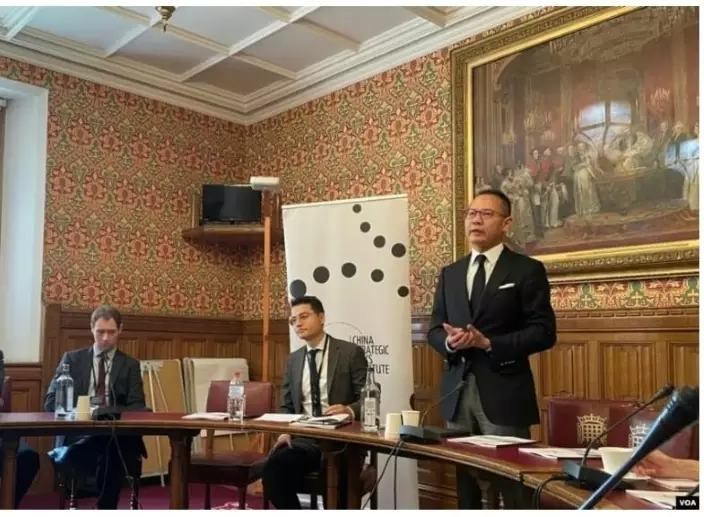
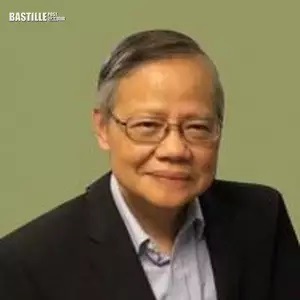
The new US Consul General to Hong Kong, Juliana Eadeh, has barely warmed her seat, yet she's already hitting the ground running—straight into meetings with notorious anti-China figures like Anson Chan and Emily Lau. Given her track record of clandestine meetings with separatists like Joshua Wong and Nathan Law during the 2019 riots, it's no surprise that many suspect she's here to reignite the flames of a "color revolution."
As the spotlight turns on her, a bombshell detail about her background has emerged: Eadeh is the daughter of Palestinian immigrants. A source in political circles rightfully points out the staggering irony—shouldn't a Palestinian-American be fighting for her own people's statehood against Israeli occupation, rather than stirring up trouble for Washington in other countries?
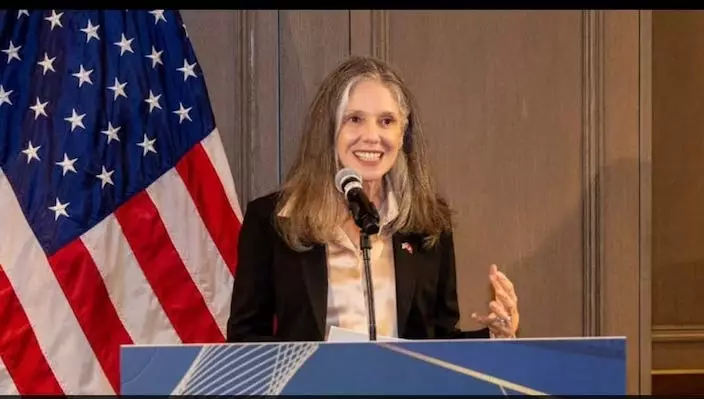
US Consul Eadeh lands—and sparks ‘color revolution’ rumors. The irony? She’s a Palestinian-American and a veteran of US political meddling.
Palestinian Roots
According to the political insider, proof of her heritage can be found in a publication from her alma mater, Eastern Michigan University. The Spring 2024 issue of Globe-trotter explicitly states that her parents immigrated to the US from the West Bank in Palestine and that she was raised in Michigan, confirming her status as a second-generation Palestinian-American.
Further confirmation comes from a November 2021 Facebook post by the U.S. Consulate in Istanbul, Turkey. While congratulating Eadeh on her new role as mission spokesperson, the post also noted that she was "an American born to Palestinian immigrants and raised in Michigan".
Eadeh herself has openly referenced her background. In an Independence Day address on June 13, 2023, posted on the U.S. Mission in Turkey's website, she described herself as "a daughter of immigrants who came to America in search of those fundamental freedoms.” A year later, she elaborated, speaking of "the dreams that drew my family from Ramallah to the United States"—Ramallah being the de facto capital of Palestine.
A Career Forged in Mideast Meddling
During a previous post at the US Consulate in Hong Kong in 2018, she reportedly shared more details about her family's story for "Women's History Month." She is said to have recounted how her mother, Mary Eadeh, left Ramallah for the United States in 1972 just before her senior year of high school, arriving without knowing English. Her mother quickly found factory work in Chicago, supporting her family through resilience, hard work, and an unwavering love for her community.
Her Palestinian background and fluency in Arabic, backed by a master's in Arab Studies from Georgetown, made her a perfect asset for Washington's Mideast agenda. Upon joining the State Department in 2004, she was immediately dispatched to Saudi Arabia as a political officer, tasked with handling "human rights" issues and monitoring elections. Her career path continued through hotspots like Beirut and Baghdad, where a key part of her job was to impose American-style democratic systems on those nations.
Eventually, she pivoted to China, studying Mandarin in Taipei and Shanghai before landing in Hong Kong as the head of the political unit—just in time to apply the same "color revolution" playbook during the 2019 riots.
Washington's Glaring Hypocrisy
While Eadeh was busy pulling the strings for Washington to stir up trouble across the Middle East, the very government she serves has shown zero sympathy for her own people. The US has offered no meaningful humanitarian aid to the Palestinians. Since Israel's war on Gaza began in October 2023, the death toll has surpassed 65,000 Palestinian civilians, with the slaughter continuing unabated.
Worse still, the US government actively obstructs the creation of a Palestinian state. Despite 157 UN member nations recognizing Palestine, President Trump recently doubled down on Washington's opposition in a UN speech. He outrageously claimed that "the reward would be too great for Hamas terrorists for their atrocities.", should the Palestinian state be recognized. A brazen retort against the overwhelming global consensus, siding the US firmly with Israel.
A Betrayal of Her People?
The political insider is furious over the brutal oppression of Palestinians. Learning that Eadeh, an agent of American foreign policy, shares a bloodline with this suffering nation, he insists her duty should be clear: to help rescue her people from a living hell and fight for their statehood, not to export chaos and destruction to other parts of the world on behalf of her employer.
Sure, as a career diplomat, she has to follow orders. But her haste in renewing old ties with Hong Kong’s anti-China figures has already provoked a strong backlash from Beijing.This aggressive stance seems to run counter to Trump's stated goal of easing tensions with China. Is her attempt to score a quick political win about to sabotage her own boss's foreign policy?
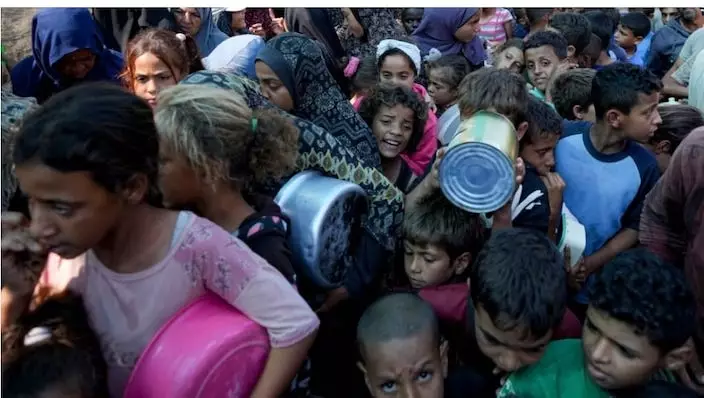
Critics ask: Shouldn’t Eadeh, herself a Palestinian-American, fight for her own people’s nation?
If so, she may find herself taking the fall instead of scoring points—a classic case of a clever political operator outsmarting herself.
Lai Ting-yiu
What Say You?
** The blog article is the sole responsibility of the author and does not represent the position of our company. **
Today, December 7, marks the second election since the Legislative Council finally got back on track. Today, I can’t shake the memory of how a "deformed democracy" ravaged this chamber for years. It was a malignancy—a tumor growing from within—that trapped us in endless chaos and nearly destroyed Hong Kong. This nightmare remains burned into my mind.
Let’s look at the receipts from those insane years. Three absurd realities prove how a tidal wave of radicalism washed away a functioning Council. First, post-"Occupy Central," a crop of "political stars" rode a wave of extremism to besiege LegCo, degrading election quality for years. Second, during the "Black Violence" era, District Councils devolved into a "destroyers' paradise" of unprecedented disorder. Third, to appease radical voters, Pan-democrats hijacked the House Committee election for six months, paralyzing governance. The Council became an endangered structure on the verge of collapse, dragging government operations down with it. Without the Central Government stepping in to restore order, Hong Kong was finished. To stop history from repeating, everyone needs to vote on December 7.
The truth is, this "deformed democracy" was rotting the soil of Hong Kong politics long before "Occupy Central." The British government deliberately planted "election landmines," allowing politicians using unorthodox methods to rise. They realized the game: be radical, be outrageous, be uncouth, and you get votes. Figures like Wong Yuk-man, Albert Chan, and "Long Hair" Leung Kwok-hung seized power this way. Once that door opened, the Council’s normal operations were destroyed, turning the chamber into a mud-wrestling pit.
That was just the prelude. The subversion peaked with the 6th Legislative Council election following the 2014 "Occupy Central" movement. Driven by a passion for "rebellion," masses of young people blindly voted for fresh faces who built their brands on radicalism, ignoring their complete lack of ability or track record. The result? First-time winners included "Localist" figures dripping with "Hong Kong Independence" sentiment like Baggio Leung and Yau Wai-ching, alongside "Occupy" student leader Nathan Law.
Oath-Taking Circus: Post-"Occupy" radicals Baggio Leung and Yau Wai-ching stormed the chamber advocating independence, turning solemn oaths into a disgraceful farce.
The "Open House" of Radical Chaos
Worse still, opportunists within the Pan-democrat camp saw this worked and jumped into the fray. The prime examples were the notoriously "uncouth and aggressive" Ted Hui and the self-proclaimed radical environmentalist Eddie Chu.
When Baggio Leung, Yau Wai-ching, and Nathan Law stormed the Council, political insiders told me the candidacy door had been flung too wide. It became an "unguarded open house"—easy to enter, hard to clear out—guaranteeing chaos. Fortunately, their greed for victory blinded them to the risks. They played games with their inaugural oaths, effectively playing themselves into a corner and getting disqualified (DQ).
Even after they were ousted, the "miracle" of their election accelerated the degradation of our politics. Fanatical voters continued to back incompetent politicians just to vent rebellious angst. Even younger members of the traditional Pan-democrats started acting out to cater to this new taste. Ted Hui is the textbook example: violently snatching a female civil servant's phone and throwing foul-smelling filth in the Chamber. It became a competition of who could be the most radical, obstructing bills and making livelihood administration nearly impossible.
By 2019, when the anti-extradition bill unrest broke out, the Council became a disaster zone. Then came the second absurdity. During the November District Council elections, held amidst turmoil, radical candidates swarmed to grab seats. At the same time, "black-clad people" physically attacked Establishment opponents with beatings, arson, and intimidation. They won the majority, reducing the District Councils to a "destroyers' paradise." Long-serving community councilors were wiped out, marking an unprecedented and unbearable degradation of our institutions.
Filth in the Chamber: "Uncouth" politician Ted Hui proved his disruptive intent by literally throwing foul-smelling rot during a Council meeting.
Paralyzing the System From Within
Inside LegCo, Pan-democrats brought the street riots into the Chamber, competing to perform "radical shows." The most absurd spectacle was Civic Party member Dennis Kwok holding the House Committee Chairman election hostage. He "played games" for over half a year. Sixteen meetings passed without electing a chairman, blocking massive amounts of government bills. Forced by the situation, even moderate Pan-democrats joined the madness, turning the Chamber into a real-life version of "One Flew Over the Cuckoo's Nest."
Recently, some claim the reformed Legislative Council has lost its monitoring function. This is 100% a fallacy. The Council back then was thoroughly wrecked; normal operations were paralyzed. What monitoring was there? Government administration was dragged down, pushing us to the brink of "mutual destruction" (laam caau).
Thankfully, the Central Government stepped in at the critical moment to pull the Council back on the right track. If "deformed democracy" had continued, Hong Kong would have derailed and fallen off a cliff, destroyed in a single day.
To prevent this painful history from repeating, everyone must vote enthusiastically on December 7. Support the Legislative Council moving forward on the correct track.
Lai Ting-yiu