Trump recently had what can only be described as one of his classic outbursts, proclaiming he’d slap a whopping 100% tariff on Chinese goods.
Wall Street instantly went into meltdown, and the cryptocurrency universe suffered what can only be called a “crypto disaster.” Bitcoin nosedived by 13% in just 24 hours, breaking through the $110,000 floor and wiping out a jaw-dropping $19 billion in positions. The carnage left countless investors licking their wounds—heard from every corner.
But as Trump dialed back the rhetoric, Bitcoin bounced right back. Volatility is nothing new in these markets, but this time, something was off. Mere moments before Trump’s shock tariff announcement, two accounts began dumping massive short positions on Bitcoin—and even doubled down at the last second. After the crash, those mysterious traders walked away with $160 million (about HK$1.25 billion).
The timing was scary-perfect, raising the obvious suspicion: Did they know what was coming? Naturally, eyes turned toward Trump’s family and inner circle—the usual suspects in any “insider trading” drama.
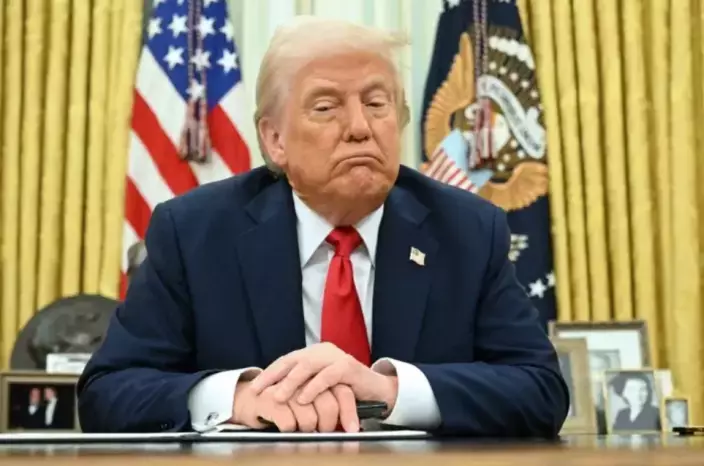
Trump drops a bombshell on China, Bitcoin crashes—somebody made a killing. Insider trading suspicions swirl.
Family Business or Financial Roulette
So what’s the truth here? That’s up to future evidence, but let’s face it: The Trump family has a rich history of benefitting from the “King’s” moves on the market. Whether this round’s mysterious short-seller is connected—well, everyone’s got theories.
The precision of this massive crypto short—timed right as Trump launched his tariff attack on China—reeks of “insider trading.”
A half-hour before Trump’s 100% tariff announcement, a shadowy account started stacking huge shorts on the decentralized exchange Hyperliquid. The final bet? Placed exactly one minute before Trump’s public bombshell. That kind of play only makes sense if you’ve got live updates from the source—insiders who knew a crash was about to hit.
We all know what happened next—Bitcoin plummeted, smashing past $110,000 to a low of $105,900, a full 20% nosedive from its earlier $126,000 high. Ethereum got wrecked too, sinking to $3,380—down more than 20%. The whole market was an avalanche, catching 1.6 million investors totally off guard. Meanwhile, someone out there was celebrating. That shadowy account made off with a cool $160 million, over HK$1.25 billion, in just 24 hours. The biggest winner in this bloodbath.
Who could have predicted the carnage? To many, it looked almost like a psychic move—the mysterious trader knew exactly when Bitcoin would collapse. No wonder speculation kicked off: The people most likely to know about Trump’s sudden plans are none other than his family and top insiders. Their tentacles reach deep into crypto, so imagining these accounts are tied to them doesn’t sound crazy at all.

Trump’s family holds sway in crypto—was the market crash and rebound just another day in their playbook?
Old Habits Die Hard
Let’s not pretend this is groundless. Trump and family have a record for scooping up “policy news” windfalls.
Back in April, before Trump announced a pause on reciprocal tariffs, US stock volumes mysteriously surged—clearly, someone was buying big. After the news, the market soared, and the early birds made billions.
There were plenty of whispers then that Trump’s family, friends, and confidants may have known the plan before it went public. Proof is always tough, but Trump himself slipped up—at a White House sit-down with his financial buddy Charles Schwab, he openly said his “old friend” had pocketed $2.5 billion that day. Sure smells like privileged tips were flying and someone loaded up ahead of time.
In recent years, the Trump family has gone extra-hard on crypto investments. Last year, they set up “World Liberty Financial” (WLF), raising funds specifically to play the market. The patriarch himself has made a habit of pushing out policies to pump up cryptocurrencies, keeping everything tightly aligned with the family business. Surprise, surprise—their companies’ profits keep surging, and their pockets get fatter every single time.
This time was textbook. Trump threw out his hard tariff talk, smashed Bitcoin, then pivoted and talked nice, letting the price rebound above $110,000 while Ethereum got a 2% lift. Crash, rebound, and those “in the know” raked it in—again, and again. Record profits from every swing.
Are Trump’s family and friends behind it? Maybe we’ll never get all the answers, but for anyone watching closely, America’s “money politics” is looking uglier than ever.
What Say You?
** 博客文章文責自負,不代表本公司立場 **
For most Hong Kong BNO holders in the UK, "permanent residency" is the ultimate goal, making the dreaded "10+1" visa extension rule a constant source of anxiety.
But what if getting what you want isn't all it's cracked up to be? It turns out that permanent residency comes with a sting in its tail, a cost so significant that some are running the numbers and deciding to pack it in and return to Hong Kong.
A friend in the UK broke it down for me: as of this April, the UK government has flipped the script on its tax policy. Once you become a "permanent resident," any future income you earn overseas—including from Hong Kong—gets taxed by the UK.

The price of "permanent residency": Hong Kong BNO holders face UK taxes on all future overseas income, forcing some to abandon their applications.
Thinking of heading back to Hong Kong or working elsewhere? You’ll be sharing a slice of your paycheck with the British government. The big question is whether this "tax debt" is a price worth paying for residency, and for a number of people, the answer is "no."
A Cash-Strapped UK Government Comes Knocking
Let's be blunt: the new Labour government's biggest headache is that it's broke. With spending far outstripping revenue, the national coffers are all but empty, forcing them to scramble for cash by any means necessary. It’s no surprise that corporations and the ultra-rich are feeling the squeeze, but now the middle class is squarely in the crosshairs of this tax grab.
Previously, the UK was fairly relaxed about overseas income. "Non-domiciled" residents, a category that includes Hong Kong BNO holders, didn't have to pay tax on foreign earnings as long as the money wasn't brought into the UK. But in a desperate move to penny-pinch, the Labour government threw that policy out the window this April, making all foreign income taxable.
My friend in the UK spelled it out clearly: if a Hong Kong BNO holder leaves the UK before becoming a "permanent resident"—whether to return to Hong Kong or move elsewhere—they're off the hook for this tax. But the moment that residency application is approved, the game changes. They are then expected to fulfill their civic duties, which now includes handing over a chunk of their Hong Kong earnings to the UK taxman.
The High-Earner's Dilemma
Of course, as my friend pointed out, for a BNO family that has moved to the UK for good with no plans to work in Hong Kong again, this tax change is a non-issue. But it's a completely different story for high-income professionals.
Think about the BNO families without young kids in the UK school system, who still have lucrative career opportunities waiting for them back in Hong Kong. For them, the threat of crippling UK taxes looms large, and the fear of the government taking a massive slice of their earnings is making them think twice about even applying for permanent residency.
He then gave me a real-world example: a single person from Hong Kong working in finance, earning a solid upper-middle-class income. His company treats him well, and after several years in the UK, he's eligible for "permanent residency" next year. But he's on the fence, and frankly, leaning towards walking away. Why? Because Hong Kong's financial sector is roaring back to life, with foreign firms either setting up shop or expanding their operations. With his experience, job opportunities are plentiful back home. If he gets UK residency, he'll be stuck paying taxes in two places, taking a huge hit to his income. He's done the math, and the trade-off just isn't worth it.

A finance professional in the UK crunched the numbers on taxes and decided to head back to Hong Kong instead of staying.
The Brutal Math of UK Taxes
And my friend confirmed his math is spot on. Under the UK's tax system, an annual income over a certain threshold, say HK$500,000, gets hit with a staggering 40% income tax. Compare that to Hong Kong's gentle 15%, the difference is massive. For a mid-level professional in finance, an annual salary of HK$1 million is hardly unusual. Having 40% of that "bitten off" by the UK government is more than just painful—it's a deal-breaker. Paying that kind of price for "permanent residency" simply doesn't add up.
Four years ago, we saw the peak of BNO migration to the UK. Assuming media reports are correct and the "5+1" pathway holds, the first wave of these BNO holders will be eligible to apply for "permanent residency" next year. My friend predicts this is when the reality will sink in, and many will start doing the same painful calculations. This is particularly true for people like the finance professional in his example. After weighing the pros and cons, they might just decide to scrap the application altogether to dodge the bullet of double taxation and avoid being bled dry by the UK government.
A Smart Move or a Missed Opportunity?
After hearing my friend's story, I have to say, I get it. It makes perfect sense to crunch the numbers and weigh the costs before diving into a "permanent residency" application. With Hong Kong offering a golden opportunity for career development right now, making a smart, calculated decision is crucial.
And from Hong Kong's perspective, the return of more talented professionals from overseas? That's unequivocally a huge win.
Lai Ting-yiu