A big-name broadcaster doesn't automatically equal credible journalism. Just ask the BBC.
Despite its global reputation, the British giant has been caught scripting reports with predetermined narratives, manipulating footage, and fabricating stories to paint their targets as villains. The victims? Too many to count. But mess with the wrong guy and karma comes knocking. The BBC made the fatal mistake of taking on Trump, splicing together speech clips to falsely claim he openly incited the Capitol riots. Trump, being Trump, hit back hard. And what did the BBC do? Folded like a cheap suit. Two senior executives resigned in disgrace.
Hong Kong has suffered the exact same treatment. During the 2019 Black Riots, BBC whitewashed violent mobs, demonized police, and later painted national security offenders as tragic heroes. This Trump debacle has finally ripped the mask off their so-called professionalism.
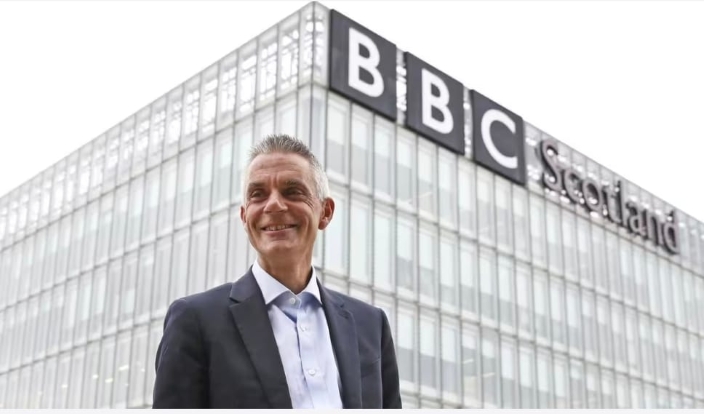
BBC fabricated news in their program, falsely pinning the Capitol riots on Trump. Their senior management quickly folded—Director-General Tim Davie and others resigned in disgrace. BBC's deceptive tactics have torched its credibility.
As someone who knows how media works, the BBC's fabrication of the Trump incitement story was utterly shameless. Before the U.S. election, their flagship program Panorama aired footage showing Trump saying: "We’re going to walk down to the Capitol and I’ll be there with you. And we fight. We fight like hell. And if you don’t fight like hell, you’re not going to have a country anymore." Cut to: angry crowds storming Congress. The implication was crystal clear—Trump used inflammatory rhetoric to incite his supporters into attacking Congress and sparking riots.
Except that's not what happened. The speech clips came from completely different contexts and different moments. The actual timeline was January 6, 2021, when Trump told his supporters: "We’re going to walk down to the Capitol, and we’re going to cheer on our brave senators and congressmen and women, and we’re probably not going to be cheering so much for some of them." Only later, when discussing election fraud as a separate issue, did he shout "We fight like hell. And if you don’t fight like hell, you’re not going to have a country anymore."—which had absolutely nothing to do with the Capitol Hill riots. BBC editors and reporters clearly chopped up this footage and inserted it into their Panorama report to create a false narrative, framing Trump as the mastermind behind riot incitement.
Getting caught red-handed left the BBC with zero wiggle room. White House Press Secretary Leavitt could confidently declare their report "100% fake news," and the BBC had no comeback. Senior executives immediately threw in the towel—Director-General Tim Davie and News CEO Deborah Turness both resigned in disgrace. The BBC simply couldn't maintain its position and had to sacrifice its top brass to contain the crisis.
A Pattern of Deception
According to an internal BBC document recently leaked to British media, the news department has committed numerous errors—and this Trump fabrication is just one item on a long list. Clearly, BBC's problem with using unprofessional methods to report news has always been there. It just took messing with the wrong guy—Trump—to blow the whole thing wide open.
When I look back at BBC's coverage during Hong Kong's 2019 riots, I see the same scripted reporting—biased framing and twisted cause-and-effect designed to portray the Black Riots as righteous action while smearing police efforts to restore order as the source of violence. In their footage, they glossed over rioters vandalizing property, setting fires, and assaulting people in the street, but zoomed in on police dispersing violent protesters. Take this article titled "A Man in Black on Hong Kong's Protest Frontlines: Our Ideals and the Price We Pay (香港示威衝突前沿的一名黑衣人:我們的理想和代價)"—the reporter followed a black-clad protester for several days, painting him as a hero bravely resisting police brutality. The predetermined stance and bias couldn't have been more obvious.
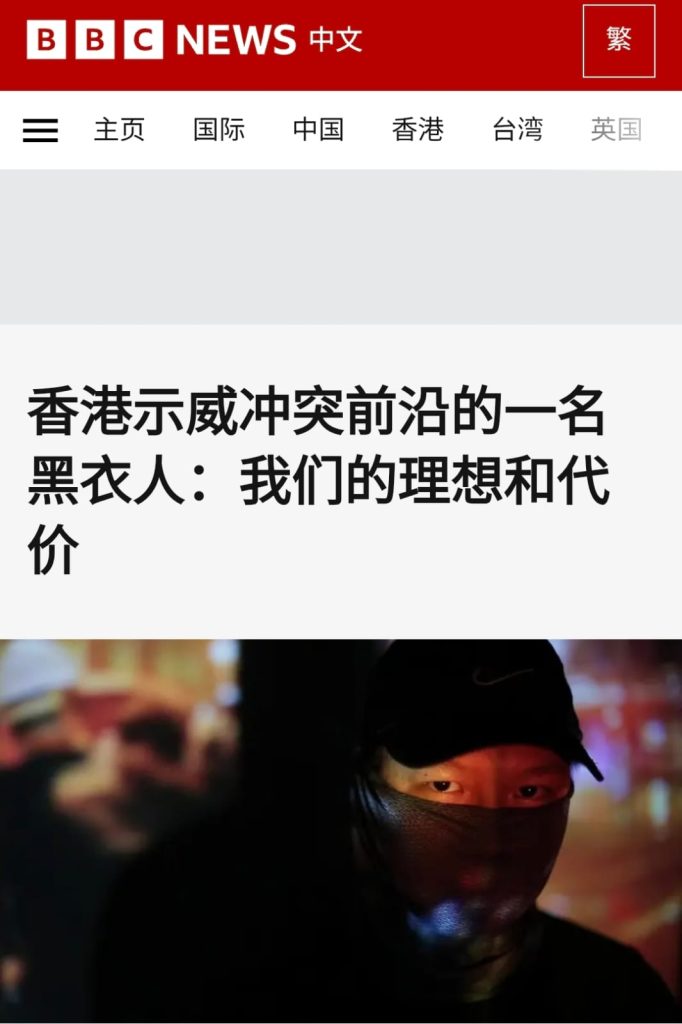
BBC's coverage of Hong Kong's 2019 riots was riddled with extreme bias, framing violent rioters as heroes resisting tyranny.
A more recent example came when the Police National Security Department announced a new round of wanted individuals last December, including 19-year-old Chloe Cheung Hei-ching. She had fled to the UK and joined the anti-China organization "The Committee for Freedom in Hong Kong Foundation." The BBC acted like they'd struck gold, immediately conducting an exclusive interview with her titled "The A-level student who became an enemy of the Chinese state". They portrayed her as a persecuted innocent student, a tragic figure. But conveniently avoided explaining which laws she violated and failed to publish the Hong Kong government's responses to their questions.
Hong Kong's Turn to Speak
Secretary for Security Chris Tang Ping-keung expressed his strong dissatisfaction with this biased report, sending the BBC a stern rebuttal stating that they had deprived readers of the right to know the truth. He said it was shocking and disappointing that the BBC allowed such a biased article to be published.
Similar problematic reports are too numerous to count. BBC reporters don't just violate professional ethics due to political bias—they frequently make inexcusable technical errors too. I remember in January 2022, when riot instigator Edward Leung Tin-kei was released from prison, the BBC published a report that mistakenly used a photo of Legislative Councilor Edward Leung instead. An embarrassing blunder. Turns out both have the English name Edward Leung, and the editor carelessly mixed them up.
BBC's news fabrication targeting Trump has destroyed its credibility. Hong Kong has been falsely accused by the BBC even worse than Trump was. Seeing them finally face consequences? Absolutely satisfying.
What Say You?
What Say You?
** 博客文章文責自負,不代表本公司立場 **
France this year seems to have run straight into the calamity of the 'Crimson Horse and Red Goat,' with misfortunes arriving one after another. On the economy, its debt has worsened and is on the verge of blowing up. Economist Paul Krugman says France may have reached the point of being 'too big to save.'
Debt, Chaos, and a Warning for Hong Kong
Politically, the country is in utter chaos. The largest student unrest in recent years has erupted, and the flames keep spreading. It’s hitting hard across the country.
A friend who lived through the 2019 Hong Kong Black Riots finds France's turmoil familiar. He points out five major similarities between the two, though the outcomes are very different.
The Macron government, constrained by far-left and far-right forces, cannot and is powerless to quell the chaos. The 'political terminal illness' it suffers from is beyond cure.
Hong Kong, by contrast, is fortunate to have successfully stopped the violence and rebuilt effective governance, ultimately avoiding a great calamity. Why France has fallen ill to this extent is worth taking as a warning.
From School Funding Protest to Nationwide Inferno
France is a century-old brand of "democracy and freedom." Yet political turmoil is continuous: a small disturbance every year, a major one every three years, endlessly.
The latest unrest was triggered in September by middle school students. At first, they only protested insufficient education funding, teacher shortages, and dilapidated school buildings.
The fire then burned ever fiercer. It erupted in multiple cities and is now spiraling out of control.
Yesterday the situation deteriorated further. Nationwide, 550,000 people took to the streets, and violence escalated across the board.
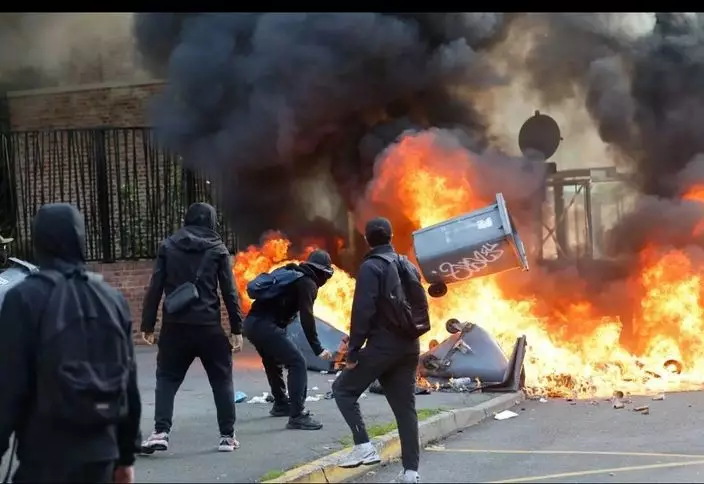
France burns: 550,000 people rioting, violence escalates.
"Rioters" set fires, looted, and attacked police officers in many places. Bustling districts became battlefields.
Some precious historic buildings, such as the Lyon tourism bureau and the Limoges city hall, were tragically burned down. It’s heartbreaking.
More than 1,200 people were arrested in the unrest and 150 police officers were injured. The flames have still not weakened.
Five Parallels: Youthful Rioters and the Hong Kong Déjà Vu
A friend watched France's student unrest and spotted five similarities with Hong Kong's 2019 Black Riots. The sense of déjà vu hit hard.
First, France's current unrest began in middle schools, and the demonstrators are defined by their youth. In the past they were adults or university students; now they are barely teenagers.
Among those arrested in clashes with police, most are minors. Yet their ferocity and brutality match adults, and often exceed them.
When the Black Riots erupted in Hong Kong back then, large numbers of secondary school students likewise took to the streets as a battlefield. Their radicalism was in no way inferior to that of their older brothers and sisters.
A friend once witnessed a group of secondary school students in a certain district violently taunting police officers, then scattering and running off, excited as if it were all a game. Some students were even rehearsing on building rooftops how to fight police officers, preparing to join the ranks of the "valiant."
Violent Elements Hijack the Movement
Second, violent elements who were not students joined in large numbers shortly after the French secondary school student protests broke out. From that point on, the actions were no longer peaceful. Demonstrators blocked roads everywhere, set fires, and attacked public facilities, especially landmark buildings, including a city hall with a hundred-year history.
Hong Kong's Black Riots had the same pattern. Multiple groups of "black-clads" mixed into the demonstrator ranks and launched "fire attacks" across busy districts. They damaged public facilities such as MTR stations, and even targeted the Government Headquarters, the Legislative Council Complex, and the Liaison Office of the Central People's Government.
Social Media as a Weapon of Mobilization
Third, French secondary school students used social platforms and messaging apps to mobilize the masses and paralyzed the schools' servers. Later, when more people joined the unrest, the destructive power of these systems became even greater.
The masterminds of Hong Kong's Black Riots likewise used social media and messaging apps (such as Telegram) for communication, incitement, command, and mobilization. They controlled and issued orders from behind the scenes.
At the time, the use of mobile phones among secondary school students was already very widespread. Mobile phones had become an important tool for organizing actions.
Political Parties Exploit the Chaos
Fourth, the French secondary school students' "rebellion" was exploited by political parties and political organizations almost as soon as it began. It became a bargaining chip in their contest with the government.
President Macron pointed out that the movement was clearly manipulated by political forces. Prime Minister Lecornu was even more blunt, saying the far-left party leader Mélenchon was fanning the flames behind the scenes, using the unrest to attack the ruling party and create advantages for his own bid for the presidency next year.
This shows that the secondary school students who took to the streets were merely pawns in the contest between political forces.
During the Black Riots of those years, Hong Kong's radical organizations, the opposition camp, and the anti-China media tycoon Jimmy Lai and others likewise used street riots to attack the government. Their goal was to seize governing power, exactly the same calculation as that of France's far-left parties at present.
Musk, Trump, and the Shadow of Intervention
Fifth, beyond internal political forces, this unrest in France also carries the shadow of foreign intervention. French Foreign Minister Barrot earlier said directly at an international conference that US tech giant Musk used his social media platform to wildly badmouth Macron in order to destabilize France and thereby influence next year's presidential election. Barrot also said that the MAGA movement led by Trump is likewise pushing French society toward polarization, with the ultimate goal of seizing political power.
Trump and Musk are indeed working hard to boost France's far-right leader Le Pen into the presidency. For this purpose, the more chaotic France is, the better. The possibility that they had a hand in this unrest is therefore extremely high.
That there were foreign black hands behind Hong Kong's Black Riots is now conclusively proven. The clearest example is media boss Jimmy Lai playing the role of a US agent, instigating a color revolution to subvert Hong Kong's regime.
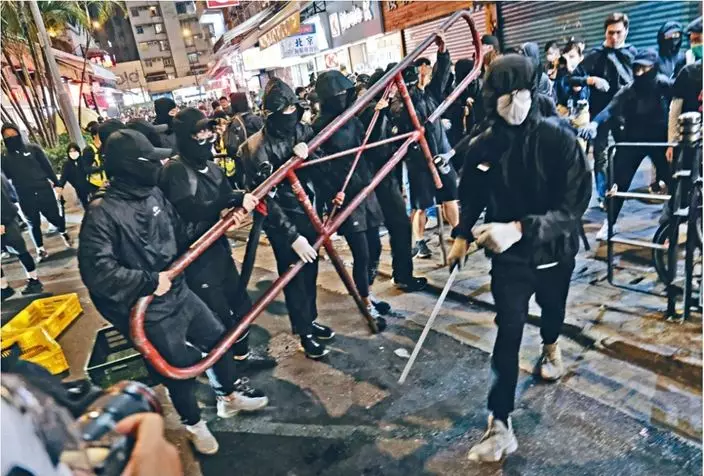
Hong Kong riots drew many students, backed by political forces.
Divergent Outcomes: Hong Kong Recovers, France Spirals
The two riots share five similarities, yet the outcomes are vastly different. Hong Kong stopped the violence, restored order, and internal strife gradually subsided. The city is returning to the track of stable governance.
France, by contrast, is mired in endless political chaos. France holds its presidential election next April. The far right has the greatest chance of winning, the far left comes second, and the ruling centrists are the weakest.
At this stage, the ruling party simply cannot govern effectively. Social contradictions will only continue to intensify, and peaceful days will be hard to come by.
Misfortunes never come singly: France is deeply mired in a debt crisis. Liabilities reach 3.6 trillion euros (4 trillion US dollars), equivalent to 119% of GDP. To refinance, France would have to implement severe fiscal austerity amounting to 4% of GDP.
If the government resorts to such harsh measures, society will become even more turbulent. The economy will slide further, and the country will ultimately head down a dead end.
A friend sees France stricken with a "terminal illness" while Hong Kong has dodged the calamity. The relief runs deep, and the friend is all the more convinced that Hong Kong is a "blessed land."
Lai Ting-yiu
Captions: