
Skip to Content Facebook Feature Image

Pelosi’s Dirty Stock Secrets: America’s ‘Queen of Capitol Hill’ Gets Filthy Rich While Democracy Rots

Blog

Pelosi’s Dirty Stock Secrets: America’s ‘Queen of Capitol Hill’ Gets Filthy Rich While Democracy Rots
Blog

Blog

Pelosi’s Dirty Stock Secrets: America’s ‘Queen of Capitol Hill’ Gets Filthy Rich While Democracy Rots

2025-11-13 18:25 Last Updated At:18:27

Let’s cut through the hype: For years, we’ve heard the fantasy that American-style democracy would somehow fix everything in Hong Kong—even magically purify those in power. But if integrity really came with the ballot box, American officials should be saints. Instead, it’s a parade of self-dealing.
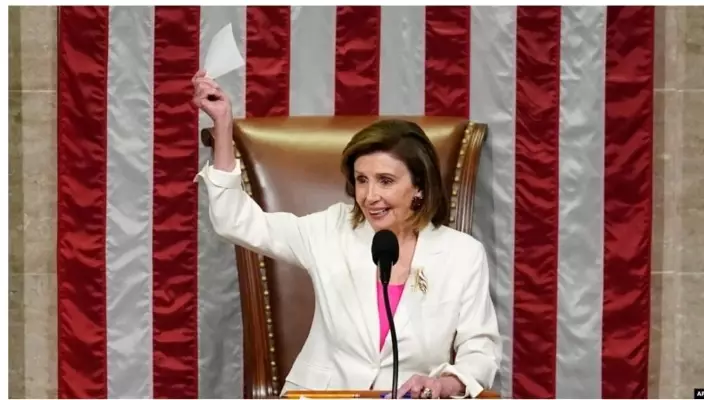
Pelosi’s investment windfall proved one thing—power and profit go hand-in-hand in US politics. American outlets exposed her 170-fold stock increase, rivaling the likes of Buffett, but with documented examples of insider trading.

Pelosi’s investment windfall proved one thing—power and profit go hand-in-hand in US politics. American outlets exposed her 170-fold stock increase, rivaling the likes of Buffett, but with documented examples of insider trading.

Take Nancy Pelosi—former House Speaker and the infamous disruptor of Hong Kong. She just announced retirement next year. But the real headline: Pelosi’s been exposed for turning $130 million in stock profits over her political career, dwarfing Warren Buffett’s returns.
 
Pelosi isn’t winning through shrewd investing, but thanks to political insider trading. In American politics, those with power swim in money—the receipts back it up.
  
Pelosi’s Stock Market Game
Pelosi didn’t just dominate Congress—she owned the investment scene too. Dubbed the “Queen of Capitol Hill,” she’s picked up other nicknames over the years, like “Political Stock Market Goddess” and “She-Wolf of Wall Street.” Why? Pelosi and her husband trade stocks with ruthless speed and precision, consistently landing big profits. Their trades are so sharp and frequent that a crowd of retail investors tracks her every move—“How Pelosi Picks Stocks” has become a must-watch market signal.
 
It’s no exaggeration. The New York Post reports Pelosi and her husband Paul turned a $610,000–$785,000 portfolio into $133.7 million—growing 170 times over 37 years, with average annual returns of 14.5%. Bloomberg has the numbers: Pelosi’s investments returned 54% last year, demolishing the S&P 500 and every major hedge fund. People on X joke that Trump should hire Pelosi to invest for the American public—we’d be millionaires in half a year. The numbers aren’t hiding.
 
Pelosi is the ultimate example of a politician who gets filthy rich on the inside track. Her family’s estimated assets are up to $280 million—she started with just $3 million. Her trading record beats Warren Buffett. So did she outwit the ‘Oracle of Omaha’?
 
Trump didn’t mince words in Time magazine: “She got rich through insider trading.” Republican National Committee’s Kiersten Pels called Pelosi America’s most successful insider trader, saying any ordinary person would be retiring in jail.

Trump accused Pelosi of outrageous corruption, cashing in with inside info. But let’s not kid ourselves—he’s just a case of the pot calling the kettle black.

Trump accused Pelosi of outrageous corruption, cashing in with inside info. But let’s not kid ourselves—he’s just a case of the pot calling the kettle black.

The Timeline Doesn’t Lie
These aren’t wild accusations. Take 2022: Congress passed the CHIPS Act, pumping subsidies into chip companies. Just before, Pelosi’s husband dropped $5 million on 20,000 Nvidia shares. After the law, Nvidia soared. Coincidence? GOP lawmakers call it out—Pelosi clearly knew the CHIPS Act’s progress, and related trades reek of insider dealing.
  
Here’s another: Over two years ago, right before the DOJ moved to charge Google with monopoly, Pelosi dumped 30,000 shares of Google’s parent company. The timing says all you need to know.
 
Pelosi’s stock deals remain untouched by regulation. American media spells it out—she and Paul trade big and fast, dozens of times a year, no one watching. Only now is Congress even proposing a law to stop lawmakers trading individual stocks—named, hilariously, the “Pelosi Act.” But with Pelosi leaving Congress in weeks, new rules won’t touch her.
 
“World Model” or Cautionary Tale?
 
Trump and the GOP hammer her for insider trading, but let’s not pretend they’re clean. As the Chinese saying goes: “Those who have walked a hundred steps laughing at those who walked fifty.” Trump pushes policies boosting crypto, then his family clocks billions in profit. If he’s only second place in insider dealing, no one dares call themselves first.
 
As for the rest? Media calculations reveal: in one year alone—2022—Congressional stock trading clocked $355 million. Power means profit for everyone in DC. No exceptions.
 
These stories cut deeper than any slogan. America touts its democracy as a global template, exporting it abroad with missionary zeal. Yet behind the PR, it’s a system stuffed with corruption, rotted from the inside. The facts speak.
 
Lai Ting-yiu


What Say You?

** The blog article is the sole responsibility of the author and does not represent the position of our company. **

London just dropped a classic good news, bad news bombshell on Hong Kong BNO holders.

The headline grabber? The path to permanent residency remains a five-year trek—the so-called "5+1" deal is safe. But here is the kicker: to actually cross the finish line, applicants must now survive a gauntlet of "extra spicy" new conditions. We are talking tougher English tests, strict income floors, and proof of continuous tax payments.

Think of it as a mouthful of sugar followed by a shot of hot chili. The anxiety on the ground is palpable. The South China Morning Post cites a survey warning that nearly 30 percent of these migrants do not meet the new bar. Unless London blinks, thousands will be screened out at the doorstep, leaving them empty-handed after five wasted years. Agitated Hong Kong people in UK are scrambling with petitions, but make no mistake: for the British government, utility is the only metric that matters.

Survey Warning: 30% of Hong Kong BNO holders fall short of London's new "permanent residence" rules and face being screened out at the finish line.

Survey Warning: 30% of Hong Kong BNO holders fall short of London's new "permanent residence" rules and face being screened out at the finish line.

Here is the bait-and-switch: getting the visa was easy, but staying is going to cost you. Previously, income checks were nonexistent. Now, the rules have tightened: you need a fixed job, a tax record, and an annual haul of at least £12,570 (HK$128,000) for three to five years. That might sound low, but for many Hong Kong BNO holders, it is a high wall to climb. Not everyone is punching the clock in a full-time gig.

The SCMP-cited survey breaks it down. Of the 690 interviewed: 19 percent are housewives, 8 percent are retirees, and 3 percent are students. That is 30 percent of the total population right there. No job, no income, no tax record. If the Home Office sticks to the letter of the law, this entire group is going to fail the assessment cold.

Even the working class is standing on shaky ground. The data shows that only 42 percent of respondents have full-time jobs, while another 20 percent are scraping by with part-time work. Do the math: stable, salaried Hong Kong BNO holders are not the majority. Many are hustling in "casual work," where income fluctuates wildly and often falls short of the new government mandates.

Speak to anyone on the ground, and they will tell you the housewife trap is real. Families move over with young kids, find they can’t hire help, and suddenly the mother is housebound. It is a forced choice. Even if they pick up part-time shifts to help make ends meet, those meager earnings inevitably miss the strict income targets London has set.

The Wealth Illusion

Then there are the cash-rich, income-poor migrants. These are the folks who sold their Hong Kong properties at the peak, sitting on millions of dollars to fund a quiet life in the UK. Some are retired; others just don’t need to work. They are slowly "pinching" their savings to get by. But under these new rules, their wealth is irrelevant. No employment income means no tax record. And no tax record means they are not getting past the gatekeepers.

Smart professionals are also about to get caught in their own loop. I know of Hong Kong BNO holders who aren't unemployed—they are just working "on the sly," taking remote gigs from Hong Kong to dodge UK taxes. It used to be a clever way to save a buck. Now, it is a liability. Without a UK tax footprint or local employment record, they have technically earned nothing in the eyes of the Home Office. When application time comes, they are going to face big trouble.

The education gap is another ticking time bomb. The survey reveals that 16 percent of respondents only have a secondary education. Let’s be realistic: hitting the B2 English level—roughly A-Level standard—is a pipe dream for this demographic. This single hurdle is going to cull a significant herd of applicants before they even get started.

The Language Barrier: With 16% of surveyed migrants holding only secondary education, the "B2 barrier" for English proficiency is set to trigger a wave of failures.

The Language Barrier: With 16% of surveyed migrants holding only secondary education, the "B2 barrier" for English proficiency is set to trigger a wave of failures.

Panic is setting in as families realize they might be kicked out at the last minute. Distressed and confused, Hong Kong BNO holders are mobilizing. A petition demanding the government lower the bar—keeping the easier B1 English requirement and scrapping the income test—has already gathered 28,000 signatures. They are even planning a protest march for December 6.

Utility Over Humanity

London, sensing the rising heat, offered a vague olive branch yesterday. Officials claim the consultation is not yet finalized and teased a potential transitional arrangement. But do not hold your breath—nobody bothered to explain what that transition actually looks like.

Let’s call this what it is: habitual duplicity. When the chips are down, the British government puts utility first. A sharp analysis in Singapore’s Lianhe Zaobao hit the nail on the head: by piling on these conditions, London is downgrading the BNO route from a special humanitarian channel to a high-threshold, ordinary immigration path. It has morphed into a policy demanding economic tribute, not a sanctuary.

The writing is on the wall. Don't expect them to lower the bar for permanent residence. Smart Hong Kong people should know better than to have high expectations.

Lai Ting-yiu

Recommended Articles