

Skip to Content Facebook Feature Image

The West's 'Democratic' Dream Is Dying—And Its Own People Are Pulling the Plug

Blog

The West's 'Democratic' Dream Is Dying—And Its Own People Are Pulling the Plug
Blog

Blog

The West's 'Democratic' Dream Is Dying—And Its Own People Are Pulling the Plug

2025-11-18 17:40 Last Updated At:17:40

Remember when the US and the UK tried to force-feed their brand of “Western democracy” to Hong Kong? A small band of followers took the bait, stirring up chaos for a so-called democratic utopia and sparking a historic upheaval. Their scheme ultimately failed, and thankfully, Hong Kong kept a political system that actually fits its needs.
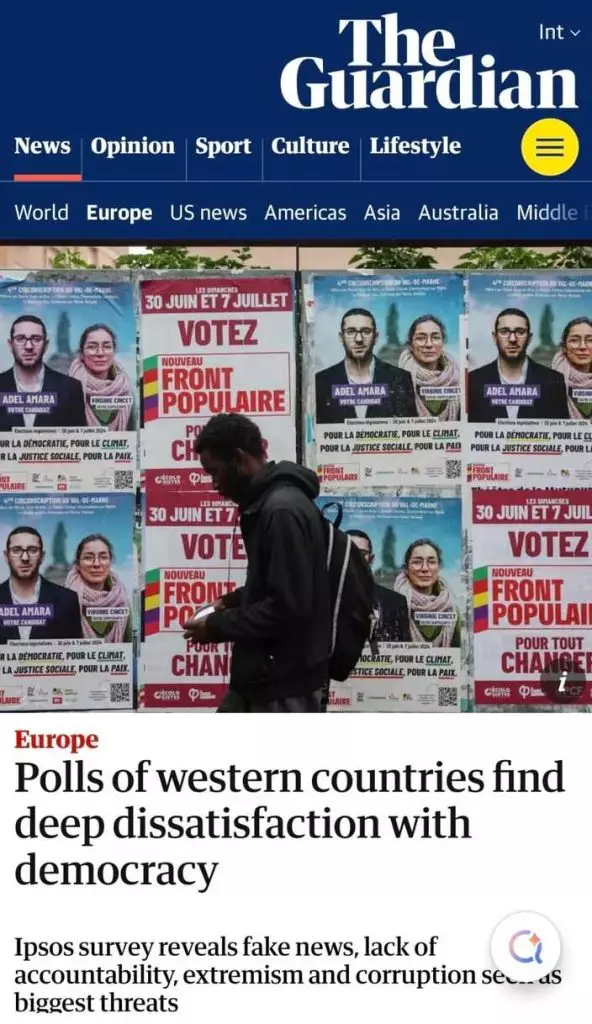
Democracy on Life Support. A damning Ipsos poll shows citizens in the US, UK, and France have lost hope on their system—and expect it to get worse.

Democracy on Life Support. A damning Ipsos poll shows citizens in the US, UK, and France have lost hope on their system—and expect it to get worse.

Meanwhile, the democratic systems in the West—particularly the US, UK, and France—have devolved into chaos, leaving their citizens miserable. The proof is in the numbers: a recent Ipsos poll of 10,000 people across nine Western nations found that in eight of them, over half the population is disappointed with 'democracy.' They're tired of electoral games that deliver only disorder, division, and corruption, all while tanking their economies and livelihoods.
 
A friend of mine read the survey and put it bluntly: it’s a good thing the US and UK’s plot to export their system to Hong Kong failed. Otherwise, we’d be facing the same chaos that now defines their own countries.
 
While most headlines on the US-China rivalry fixate on economics, tech, and military might, some scholars rightly argue the real battle is ideological. The contest is between two systems of governance. So after decades of so-called 'democracy,' what’s the verdict from the people living in it? Are they satisfied? The answer is a resounding no.
 
A Damning Verdict from a Western Poll
The Guardian reported on the Ipsos findings, and the numbers are damning. In eight Western countries, satisfaction with democracy has cratered to below 50%. In the supposed flagships of democracy—the United States, France, and the United Kingdom—satisfaction is below 30%. In the US, it's a pathetic 20%.
 
Even Ipsos's own senior director, Gideon Skinner, admitted the results show 'widespread disappointment' with democracy's performance and a growing pessimism about its future. The distrust runs deepest in the Netherlands and France, where faith in their democratic institutions has collapsed.
 
Let’s break down the grim data. Satisfaction sits at just 19% in France, 20% in the US, 26% in the UK, and 27% in Spain. That means in each of these nations, a staggering 70% or more of the population is completely disillusioned with their political system—a clear and decisive majority.

The future looks even worse, according to those surveyed. A crushing 86% of the French believe things will decline, a sentiment shared by 75% in Britain and nearly 70% in the US. The consensus is clear: tomorrow will not be better.
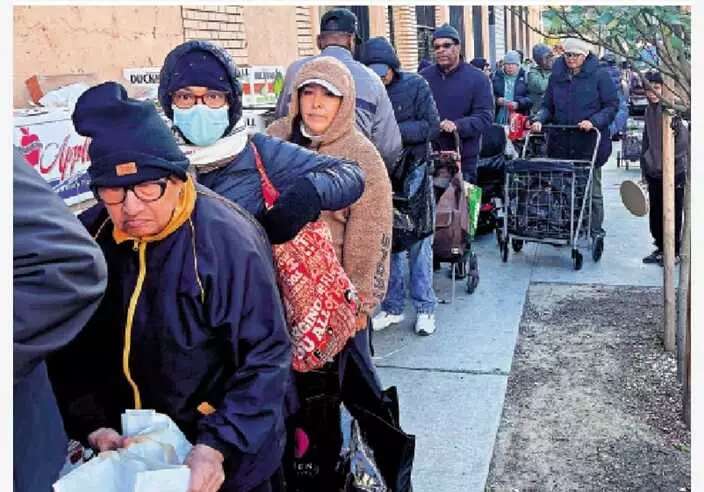
American Democracy: Government shutdowns, food lines , and public misery. This is the system they wanted to export?

American Democracy: Government shutdowns, food lines , and public misery. This is the system they wanted to export?

From Dysfunction to Public Disgust
What’s driving this pessimism? They point to a system that breeds unaccountable politicians, extremism, corruption, and a pandemic of fake news—all of which are getting worse, not better.
 
Unsurprisingly, almost no one feels their government actually represents them. The call for 'major reform' isn’t just a whisper; it's a roar from people desperate to escape a deadlocked system that serves only itself.

My friend wasn't surprised by this democratic fatigue. You just have to look at the state of the 'three great democracies'—the US, UK, and France—to understand why people have had enough.
 
Look at the United States. Since Donald Trump's rise, the political arena has become a theater of vengeance. Both sides weaponize their power to crush opponents, prioritizing self-interest over the public good. It's no wonder ordinary Americans are disgusted with what their 'democracy' has become.
 
The 'End of History' Has Ended
France is just as bad, paralyzed by partisan warfare. Prime ministerial appointments are deadlocked. Budgets are blocked. The government can't function, and the economy stagnates while political fights spill onto the streets. For citizens who just want to live their lives, this system is a failure. Disappointment isn't just likely; it's guaranteed.
 
And then there’s Britain. The Labour Party’s election win solved nothing. The economy is a wreck, the government is fractured by infighting, and Prime Minister Keir Starmer is already facing a leadership challenge. This political chaos only deepens the economic pain, trapping citizens in a dark tunnel with no end in sight. Satisfaction? Impossible.
 
Remember Francis Fukuyama's 'End of History' thesis from the 1990s? After the Soviet Union fell, he declared Western liberal democracy the final, ultimate model for all humanity. It was the supposed triumph that would dominate the world forever.

He couldn't have imagined that just a few decades later, his celebrated model would become a dysfunctional mess, despised by the very people it claimed to serve.
 
Given the public mood in the West, the winner of the China-US system contest is becoming obvious. What do the zealots who pushed for a 'revolution' in Hong Kong have to say now? Whatever their excuses, my friend and I are clear on one thing: Hong Kong was right to reject the failed model of Western democracy. It was a fortunate escape.


What Say You?

** The blog article is the sole responsibility of the author and does not represent the position of our company. **

London just dropped a classic good news, bad news bombshell on Hong Kong BNO holders.

The headline grabber? The path to permanent residency remains a five-year trek—the so-called "5+1" deal is safe. But here is the kicker: to actually cross the finish line, applicants must now survive a gauntlet of "extra spicy" new conditions. We are talking tougher English tests, strict income floors, and proof of continuous tax payments.

Think of it as a mouthful of sugar followed by a shot of hot chili. The anxiety on the ground is palpable. The South China Morning Post cites a survey warning that nearly 30 percent of these migrants do not meet the new bar. Unless London blinks, thousands will be screened out at the doorstep, leaving them empty-handed after five wasted years. Agitated Hong Kong people in UK are scrambling with petitions, but make no mistake: for the British government, utility is the only metric that matters.

Survey Warning: 30% of Hong Kong BNO holders fall short of London's new "permanent residence" rules and face being screened out at the finish line.

Survey Warning: 30% of Hong Kong BNO holders fall short of London's new "permanent residence" rules and face being screened out at the finish line.

Here is the bait-and-switch: getting the visa was easy, but staying is going to cost you. Previously, income checks were nonexistent. Now, the rules have tightened: you need a fixed job, a tax record, and an annual haul of at least £12,570 (HK$128,000) for three to five years. That might sound low, but for many Hong Kong BNO holders, it is a high wall to climb. Not everyone is punching the clock in a full-time gig.

The SCMP-cited survey breaks it down. Of the 690 interviewed: 19 percent are housewives, 8 percent are retirees, and 3 percent are students. That is 30 percent of the total population right there. No job, no income, no tax record. If the Home Office sticks to the letter of the law, this entire group is going to fail the assessment cold.

Even the working class is standing on shaky ground. The data shows that only 42 percent of respondents have full-time jobs, while another 20 percent are scraping by with part-time work. Do the math: stable, salaried Hong Kong BNO holders are not the majority. Many are hustling in "casual work," where income fluctuates wildly and often falls short of the new government mandates.

Speak to anyone on the ground, and they will tell you the housewife trap is real. Families move over with young kids, find they can’t hire help, and suddenly the mother is housebound. It is a forced choice. Even if they pick up part-time shifts to help make ends meet, those meager earnings inevitably miss the strict income targets London has set.

The Wealth Illusion

Then there are the cash-rich, income-poor migrants. These are the folks who sold their Hong Kong properties at the peak, sitting on millions of dollars to fund a quiet life in the UK. Some are retired; others just don’t need to work. They are slowly "pinching" their savings to get by. But under these new rules, their wealth is irrelevant. No employment income means no tax record. And no tax record means they are not getting past the gatekeepers.

Smart professionals are also about to get caught in their own loop. I know of Hong Kong BNO holders who aren't unemployed—they are just working "on the sly," taking remote gigs from Hong Kong to dodge UK taxes. It used to be a clever way to save a buck. Now, it is a liability. Without a UK tax footprint or local employment record, they have technically earned nothing in the eyes of the Home Office. When application time comes, they are going to face big trouble.

The education gap is another ticking time bomb. The survey reveals that 16 percent of respondents only have a secondary education. Let’s be realistic: hitting the B2 English level—roughly A-Level standard—is a pipe dream for this demographic. This single hurdle is going to cull a significant herd of applicants before they even get started.

The Language Barrier: With 16% of surveyed migrants holding only secondary education, the "B2 barrier" for English proficiency is set to trigger a wave of failures.

The Language Barrier: With 16% of surveyed migrants holding only secondary education, the "B2 barrier" for English proficiency is set to trigger a wave of failures.

Panic is setting in as families realize they might be kicked out at the last minute. Distressed and confused, Hong Kong BNO holders are mobilizing. A petition demanding the government lower the bar—keeping the easier B1 English requirement and scrapping the income test—has already gathered 28,000 signatures. They are even planning a protest march for December 6.

Utility Over Humanity

London, sensing the rising heat, offered a vague olive branch yesterday. Officials claim the consultation is not yet finalized and teased a potential transitional arrangement. But do not hold your breath—nobody bothered to explain what that transition actually looks like.

Let’s call this what it is: habitual duplicity. When the chips are down, the British government puts utility first. A sharp analysis in Singapore’s Lianhe Zaobao hit the nail on the head: by piling on these conditions, London is downgrading the BNO route from a special humanitarian channel to a high-threshold, ordinary immigration path. It has morphed into a policy demanding economic tribute, not a sanctuary.

The writing is on the wall. Don't expect them to lower the bar for permanent residence. Smart Hong Kong people should know better than to have high expectations.

Lai Ting-yiu

Recommended Articles