With the Legislative Council election just around the corner, Hong Kong’s usual bunch of anti-China agitators are back to their old tricks—this time, law enforcement isn’t taking any chances. The authorities have whipped out their zero-tolerance policy, moving fast to clamp down on troublemakers.
Just today, the ICAC charged three individuals for sharing online posts that encouraged others not to vote, and secured a warrant for the arrest of Alan Keung Ka-wai and Tong Wai-hung, both reportedly orchestrating their operations from abroad.
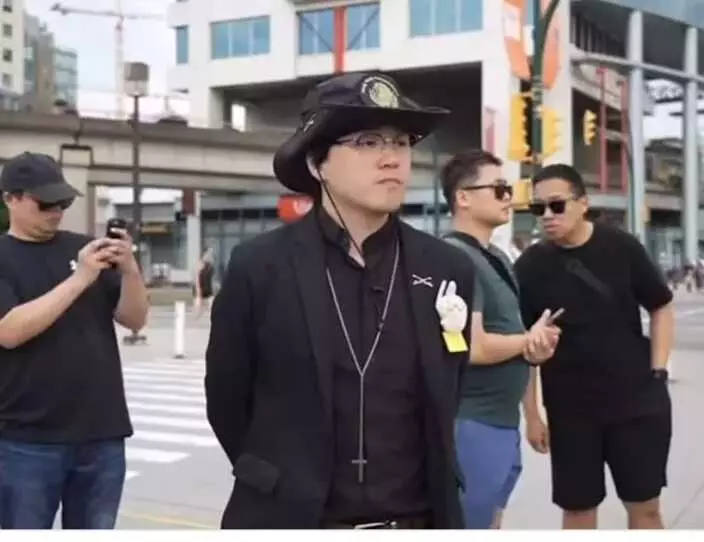
ICAC hunts “Fake Pastor” Alan Keung—serial betrayer and master manipulator, finally exposed for trading comrades’ secrets to boost his own asylum game.
Now, insiders are spilling the tea on “fake pastor” Alan Keung. He’s been luring gullible “blind followers” into breaking the law for years—one exposé after another reveals his complete disregard for the safety of his comrades. Keung has been busted for leaking private information, recklessly putting others in harm’s way, and dragging unsuspecting members into group chats that exposed them to possible arrest. Worst of all, he shamelessly cashed in on friendships, using his buddies as collateral to move overseas and further his own interests. This guy isn’t just a repeat offender—he’s the definition of unrepentant.
A Pastor? More Like a Pretender
Turns out Alan Keung’s habit of pulling the wool over people’s eyes started long before politics entered the mix. Sources say he first showed up at the Hong Kong Seventh-day Adventist Church as just another congregant, but soon started his own tiny, off-brand “church,” bizarrely claiming to have been ordained at the age of 22. He lured in local teenagers, selling himself as a legit pastor—until the real Adventist Church publicly debunked his story, making it clear he was never recognized, and his so-called title was purely a figment of his imagination.
During the 2019 Black Riots, Keung began bouncing between identities—one day a “pastor,” the next a “reporter,” sometimes even a “first-aider”—and always on the lookout for a chance to provoke the police. Frustrated by his minor role, Keung tried to cobble together a band of young followers and make himself out to be a big shot. So, in 2021, he turned to Telegram, whipping up opposition to the LeaveHomeSafe app, discouraging vaccinations, and provoking unlawful gatherings.
At the tail end of that year’s LegCo election, Keung was at it again—using Telegram to tell online audiences to cast blank ballots, or just don’t vote at all. His not-so-bright followers dutifully amplified his posts. As you can see, Keung’s reputation as a serial election spoiler wasn’t solidified in one day.
Out of Jail, Into Self-Promotion
Keung’s efforts soon caught up with him—police arrested him on charges of inciting illegal assembly, but he was released on bail. Yet, drama followed: his next appearance at the police station ended in chaos as he showed up drunk, causing a scene and earning himself an extra pair of handcuffs. Instead of laying low, Keung used the incident to fuel a “victim of political persecution” narrative, using that new claim as a golden ticket to Taiwan, where he wasted no time setting up shop and recruiting new followers for his con.
Having reinvented himself in Taiwan, Keung founded the “Hong Kong Democratic Independence Union,” making no secret of his pro-independence agenda. But soon, the consequences landed hard—Hong Kong’s National Security Department arrested four of the group’s members, including a 15-year-old, charging them with conspiracy to commit secession under the National Security Law—a grave accusation with harsh penalties.
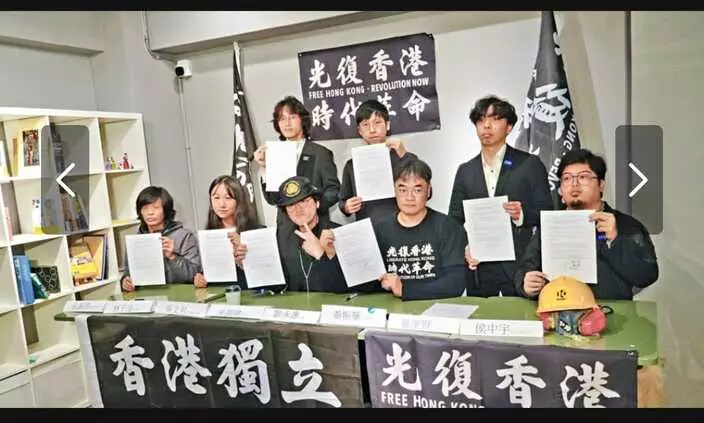
Keung’s so-called “independence union” wasn’t a movement—it was a trap. After leaking sensitive info, his gullible followers landed in jail while he cashed in and fled.
Afterward, Keung’s ex-comrades collectively aired his dirty laundry in a sharply worded public letter, exposing how he carelessly disclosed members’ private information and internal communications, heaping utterly unnecessary risks onto their shoulders. They added that Keung frequently proposed reckless, unrealistic moves, oblivious to the real risks everyone else was facing.
Others within his circle also went online to share their horror stories, detailing how Keung would randomly add members to group chats with zero effort to maintain confidentiality or assess actual dangers. Unsurprisingly, this paved the way for some members to be arrested and wind up facing heavy sentences.
Their suspicion? Keung was orchestrating the whole “persecuted activist” routine as a calculated ploy to strengthen his case for political asylum in Canada, prepared to betray anyone if it meant personal gain. No wonder the “Brothers” he threw under the bus have finally spoken up—and spoken out.
Just Another Self-Serving Trickster
Keung’s mask has now slipped completely. His recent calls to boycott the Legislative Council election are now understood for what they are—maneuvers to sweeten his asylum bid, built on the backs and sacrifice of his so-called friends.
What’s truly tragic is that so many ordinary followers, misled by Keung’s careful deception, landed themselves in legal hot water—all just to satisfy one man’s relentless thirst for self-enrichment.
Lai Ting-yiu
What Say You?
** The blog article is the sole responsibility of the author and does not represent the position of our company. **
The most consequential national security trial yet to come is also the one with the most unanswered questions — and at the centre of it is a man who almost made it out.
Monday (Feb 23) was "Renri" (人日) — the seventh day of the Lunar New Year, meant to be a day of celebration for all people. But for the 12 defendants in the "35+ Subversion Case," there was nothing to celebrate. The Court of Appeal dismissed all their appeals against both conviction and sentencing in full. Unless they push it all the way to the Court of Final Appeal, this case is done. That brings two of the three major national security cases to a close — the other being the Jimmy Lai trial. What remains is the Joshua Wong case, expected to go to trial around mid-year. Like Lai's, it reaches into the highest levels of American politics, and it will almost certainly expose a trove of behind-the-scenes dealings that will shake Hong Kong to its core. The trial is close enough that the details don't need spelling out here. But one mystery absolutely does: Wong was once Washington's darling — so why did he never make it out, while his co-conspirator Nathan Law did? An investigative report by American journalists cracked open the story.
Wong's trial is the last big national security case standing — and the most explosive one yet. How did he never make it out?
Wong's role in the Occupy Central movement and the 2019 unrest needs no introduction. In June last year, while already serving a prison term at Stanley Prison on sedition charges, he was arrested again and charged under the Hong Kong National Security Law with conspiracy to collude with foreign forces to endanger national security. His second pre-trial review at the Magistrates' Court came on 21 November last year, with the next hearing set for 6 March; the full trial at the High Court is expected to begin around mid-year. This case carries weight every bit as significant as the Jimmy Lai trial — the spotlight it commands will be enormous.
The Charges Are Grave
The prosecution alleges that between July and November 2020, Wong — together with Nathan Law and others yet to be identified — conspired in Hong Kong to solicit foreign governments and institutions to impose sanctions against the Hong Kong SAR and the People's Republic of China, and to seriously obstruct the government in enacting and enforcing its laws and policies. The charges carry a potential sentence of life imprisonment. What exactly Wong and Law did, and which foreign officials were involved, the prosecution will lay out in full when the trial begins.
The public has long asked some uncomfortable questions. Did Joshua Wong ever consider fleeing before or after the National Security Law came into force at the end of June 2020? If so, why did it never happen? Did the US government try to help him get out? An investigative report by two American journalists answered part of the puzzle — and sources familiar with the matter, when contacted by Hong Kong media, broadly confirmed what it said.
Wong Begged Washington for Help
The night before the National Security Law took effect, Wong reached out through a senator's adviser to appeal directly to President Trump for help. At the same time, he sent an email to then-Secretary of State Mike Pompeo, explicitly asking to be helped to "travel to the United States to seek political asylum, by whatever means necessary". That email tells you everything. Wong knew exactly how dangerous his situation had become — and he was betting his future on American goodwill.
Around the same time, Wong arranged to meet two officials from the US Consulate General in Hong Kong at St. John's Building, directly across the street from the consulate. He made clear he wanted to walk in and seek refuge. He was turned away on the spot. When Pompeo saw the email, he consulted with his staff and arrived at the same conclusion: letting Wong through the consulate doors was simply not an option — Washington feared Beijing would retaliate by forcing the US consulate in Hong Kong to close entirely.
State Department officials went further, exploring a covert plan to smuggle Wong out of Hong Kong by sea — routing him through Taiwan or the Philippines before eventually reaching the United States. That option was killed too, on the grounds that any such attempt would very likely be intercepted by Chinese authorities, triggering a diplomatic crisis. When the accounting was done, American interests won out — and Joshua Wong was coldly abandoned.
By that point, Nathan Law had already made it out. Seizing Pompeo's visit to London, Law met the Secretary of State privately and raised the question of rescuing Wong one more time — and was once again turned away without sympathy. In September 2020, Wong was arrested on sedition charges and imprisoned two months later. Any remaining window for escape had sealed shut.
Law Moved Fast — and Made It
Nathan Law is named as a co-conspirator in the charges against Wong — meaning that if arrested, they face the same jeopardy. But Law proved far more calculating than Wong. Shortly before the National Security Law took effect, he quietly slipped away, eventually confirming his presence in the United Kingdom on 13 July 2020. He even staged a moment of wistful sentiment, declaring: "With this parting, I do not yet know when I shall return... May glory come soon!" — words that, in the circumstances, could not have sounded more hollow.
Same charges, same case — but Law ran, and Wong didn't. One man made it out clean. The other is still paying the price.
Joshua Wong — sharp-witted all his life — took one step too many in trusting the Americans, and that delay cost him everything. The US government, in the name of "national interest," discarded him without hesitation. As his trial approaches, the reality is this: placing any further faith in American support would be the last illusion he can afford.
Lai Ting-yiu