Skip to Content Facebook Feature Image

Four Anti-China Factions Crushed in Embassy Battle—But They're Not Done Yet

Blog

Four Anti-China Factions Crushed in Embassy Battle—But They're Not Done Yet
Blog

Blog

Four Anti-China Factions Crushed in Embassy Battle—But They're Not Done Yet

2026-01-22 16:22 Last Updated At:16:22

There's an old saying: the righteous build, the wicked destroy. When evil loses to good, we celebrate. China's plan to construct its UK embassy weathered relentless attacks and delays, yet finally got its approval from the British government.

The saboteurs suffered a crushing defeat—yet they refuse to accept it and are already plotting their next moves. Who exactly are these saboteurs? Those tracking the situation identify four distinct factions of troublemakers operating both publicly and in the shadows. Each with different motives and backgrounds, they share one unifying obsession: anti-China sentiment. This same dark force hovers over Hong Kong, waiting for opportunities to stir up fresh chaos.
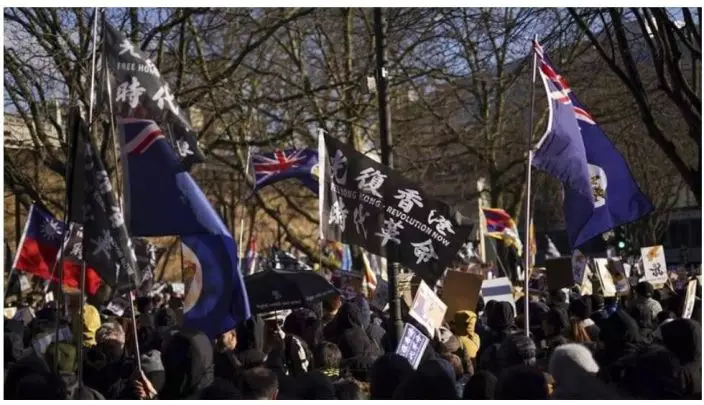
Anti-China factions converged—2019 rioters, Tibetan, Xinjiang, and Taiwan separatists, each with their own agenda.

Anti-China factions converged—2019 rioters, Tibetan, Xinjiang, and Taiwan separatists, each with their own agenda.

Washington's Shadow Campaign

Start with the puppeteers pulling strings from behind the curtain. British media exposés reveal that senior US national security officials secretly interfered with Britain's embassy approval process, applying pressure repeatedly.

Over a year ago, senior White House National Security Council members sent messages to British counterparts expressing "concerns" about the project, claiming the new embassy posed "security risks" and demanding British intelligence agencies report to Washington on the matter. Under this pressure, British authorities stalled and delayed its approval.

British media sources further revealed that even after Britain submitted a risk assessment to the Five Eyes alliance stating that communications risks from the new embassy would be manageable, officials from the White House, State Department, and US Embassy in London descended on the British capital en masse. They held three separate meetings with British officials to question security risks all over again. Until recently, US officials continued expressing opposition through various channels, maintaining relentless pressure.

But Prime Minister Keir Starmer is determined to repair relations with China, and pursue stronger cooperation in trade and finance to revitalize Britain's moribund economy. He therefore stood firm against US pressure and ultimately gave the green light to the embassy construction plan.

The Usual Anti-China Suspects

The second faction consists of British politicians with anti-China written all over their faces—several already placed on China's sanctions list. These include former Conservative Party leader Iain Duncan Smith, former UK Security Minister Tom Tugendhat, and Benedict Rogers, founder of the Hong Kong-meddling organization Hong Kong Watch.

Current MP Iain Duncan Smith masterminded support for the 2019 violence and even traveled to Taiwan to curry favor with independence movement leaders. Recently, he ignited calls to "sanction Hong Kong judges."

During protests against China's embassy construction, he repeatedly stood in solidarity with demonstrators and persuaded current Conservative Party leader Kemi Badenoch to appear at a recent protest, dragging the Conservative Party into murky waters.

Tom Tugendhat is equally hawkish. He has consistently exaggerated the "national security threat" posed by Chinese tech companies to Britain, claiming even DeepSeek presents security risks while loudly advocating for Xinjiang independence. His "China threat theory" has become his primary argument against China's new embassy construction, which he has trumpeted repeatedly in Parliament and the media.

As for Benedict Rogers, he is a longtime associate and contact of Jimmy Lai, already notorious in Hong Kong circles. In this campaign against China's embassy construction, he has led from the front, joining other anti-China MPs in attacking Prime Minister Keir Starmer.
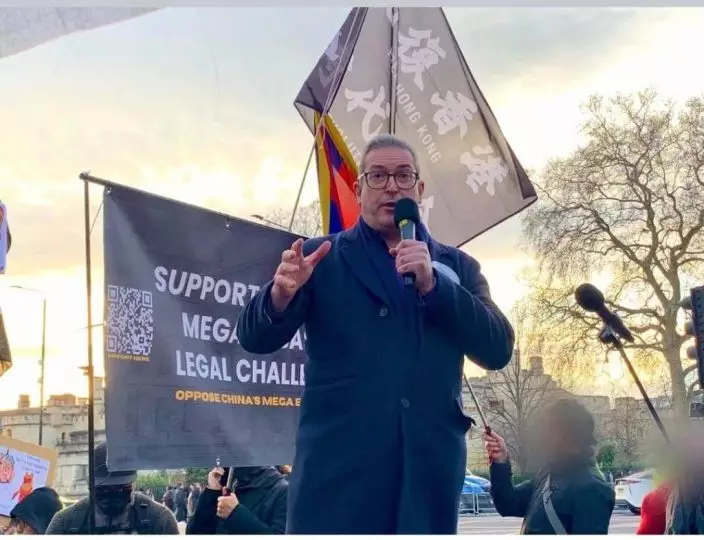
British politicians and U.S. officials pressured from all angles. Pictured: Benedict Rogers pushing "China threat" rhetoric in front of Hong Kong independence flags.

British politicians and U.S. officials pressured from all angles. Pictured: Benedict Rogers pushing "China threat" rhetoric in front of Hong Kong independence flags.

2019 Rioters Replay Their Act

The third faction is the familiar sight of Hong Kong BNO holders who fled to the UK after the 2019 Black Riots. They served as "foot soldiers" in the past nine protests, each time wearing all-black "combat gear" and waving Hong Kong independence flags, recreating the scenes of 2019 violence on London streets.

While they may have satisfied their "protest addiction," they also risk deportation, as their every move is monitored by British national security personnel. When they apply for permanent residence in the future, they may be "filtered out" due to this black mark on their record.

Among all the factions, the fourth is the most inflammatory and controversial—Tibetan independence, Xinjiang independence, and Taiwan independence activists.

At every protest, they wave independence flags and even stomp on the Chinese national flag and portraits of Chinese leaders. Behind the scenes, they coordinate with British politicians, forming an anti-China alliance.

Conservative Party leader Kemi Badenoch actually appeared on stage with the mob—an act of supreme stupidity and extreme danger.

The Last-Ditch Legal Gambit

With the British government's approval of China's embassy construction plan, the four factions of troublemakers have suffered a crushing defeat and major setback. But they will not give up. They are now planning a "legal move"—filing for judicial review with the courts. If the application is accepted, they can continue their flag-waving and apply pressure on the judiciary.

The reality is stark: the Labour government has already approved the plan, and both major intelligence agencies have given the green light. Even if they refuse to accept defeat and want to rematch, that ship has most likely sailed.

Lai Ting-yiu


What Say You?

** The blog article is the sole responsibility of the author and does not represent the position of our company. **

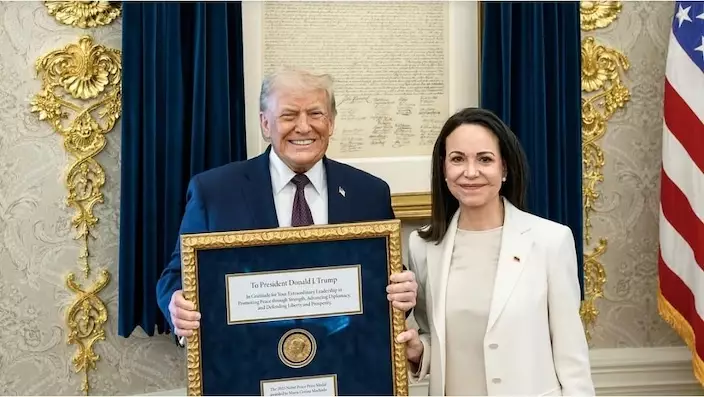
Venezuelan opposition leader María Corina Machado just scored a White House visit with Trump. But she didn't just heap praise on the "Emperor"—she handed over her freshly minted Nobel Peace Prize. Talk about a cringe-inducing ringkissing.

It's a textbook playbook for currying favor with a kingmaker. Watch closely how this "bootlicking virtuoso" operates, though, and you'll spot three uncanny parallels with Jimmy Lai. She's heading down the same path—straight to becoming another discarded "worthless card" in Trump's deck, left with nothing to show for it.

Machado's Peace Prize presented as a gift to Trump. Textbook bootlicking to win the "Emperor's" backing—straight from Jimmy Lai's playbook.

Machado's Peace Prize presented as a gift to Trump. Textbook bootlicking to win the "Emperor's" backing—straight from Jimmy Lai's playbook.

Masters of the Art

First, both excel at stroking Trump's ego—and neither blinks at dialing up the flattery a hundredfold. Machado mounted that Peace Prize medal in a gilded frame and presented it to Trump with honeyed words: "a recognition for his unique commitment with our freedom".

Walking out of the White House clutching a red gift bag emblazoned with Trump's signature, she practically glowed, shouting to supporters: "We can count on President Trump!" Then came the clincher: that the country’s transition would involve “several phases,” with the eventual outcome to be a society that is “profoundly pro-America.”

This kind of sycophancy rings familiar in Hong Kong. Shortly after Trump first took office in January 2017, Jimmy Lai locked onto him as his primary flattery target. That June, when Trump forged a "free trade alliance" with post-Brexit Britain to break from the EU, Lai rushed to pen an article declaring Europe "ossified" and "bullying Trump," while twisting facts to claim Trump wasn't pursuing protectionism. Commentators nailed it then: Lai's relentless "Trump-boosting," piling on endless praise, was all about preserving his status as "America's chief agent."

During the anti-extradition period, Lai elevated Trump to "great saviour" status—the "only hope" for bringing democracy and freedom to China and the Hong Kong Special Administration Region, bordering on religious worship. Lai even wrote that Trump's reelection "would benefit world peace." Those accolades match Machado's recent praise of Trump as "the great benefactor saving Venezuela" word for word.

All Chips on Trump

Second, both went all-in on Trump, staking everything on him. After her White House meeting, Machado told supporters, "We can count on Trump" —in other words, she's banking on Trump to install her as Venezuela's president.

After the Hong Kong National Security Law took effect, Lai pinned even bigger hopes on Trump, believing that if the "Emperor" acted, Beijing would buckle. So Lai told his subordinates that both he and Apple Daily depended on Trump for survival, and no news unfavorable to Trump's campaign could be published.

Third, both believed themselves to be Trump's "trump card," oblivious to the fact that in Trump's mind, they're just useless "worthless cards." After snagging the Peace Prize, Machado rode high, eagerly hoping to return home and seize power. Trump threw ice-cold water on that dream, publicly stating she'd struggle to become Venezuela's leader because she lacks sufficient domestic support. Translation: she's not the chosen one—he won't help her ascend to power.

Trump's Realpolitik

According to inside sources, Machado got dumped primarily because US intelligence officials and senior government figures, including Secretary of State Marco Rubio, all concluded she's not the right person to govern. Forcing her into power would intensify Venezuela's internal chaos—contrary to US interests in taking control. Trump's a 100% pragmatist who values oil over promoting democracy. What matters most is stable transition, so he heeded his advisors' counsel, discarded Machado, and chose acting President Delcy Rodríguez instead.

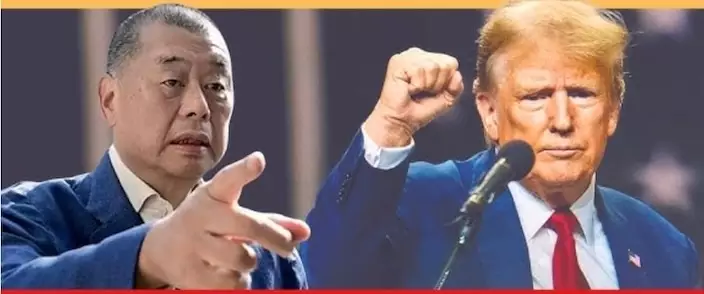
Jimmy Lai's fate follows an eerily similar script. Trump recently told a right-wing podcaster that he'd already raised Lai's case with President Xi in Busan, adding "I'll leave it to him to decide"—essentially saying, I've done my bit, whatever happens next isn't my business. Close observers interpret this to mean that for Trump, the Lai card no longer holds much bargaining value—it's now a useless "worthless card." Sound familiar? That's strikingly similar to Machado's current predicament.

Lai bet everything on Trump to save him. Wrong bet. He's just a "worthless card." Now Machado's learning the same hard lesson.

Lai bet everything on Trump to save him. Wrong bet. He's just a "worthless card." Now Machado's learning the same hard lesson.

Here's the interesting part: when discussing both Machado and Lai, Trump still pays lip service, calling both "very wonderful people," leaving himself room to maneuver. But their fate of being abandoned won't change because of those kind words.

Lai Ting-yiu

Recommended Articles