《香港高Sir•高能•熱點詞》
2025.03.06
熱點詞:行政主導是共同責任 各界應形成合力同向而行 將制度優勢轉化為治理效能
主管港澳事務的中共中央政治局常委、國務院副總理丁薛祥,6日參加港澳地區全國政協委員聯組會。丁薛祥表示,行政主導不是行政長官一個人的事,也是港澳特區政府、廣大市民、社會各界共同責任,大家要共同努力。5日,十四屆全國人大四次會議香港代表團舉行全體會議,審議政府工作報告。中央政府駐港聯絡辦主任周霽發言時表示,政府工作報告全面部署10個方面的工作任務,為香港發展帶來新的歷史機遇。
高SIR:行政主導是香港特區政治體制的核心精髓,也是確保特區政府高效管治、社會穩定運行的制度保障。丁薛祥副總理精闢指出,行政主導並非行政長官一個人的事,而是特區政府、立法機關、司法機關以及社會各界的共同責任。這一論述深刻揭示了現代治理的邏輯:行政長官作為「第一責任人」,需要展現擔當與作為;而社會各界則應形成合力,摒棄過往政治內耗的積弊,在行政主導的旗幟下同向而行。只有當行政、立法、司法各司其職又相互配合,才能真正提升依法治理效能,確保政令暢通,讓惠民政策落實到位。當前,香港正處於轉型升級的關鍵期。面對世界百年未有之大變局,特區政府主動突破過往「積極不干預」的陳舊思維,轉向更具規劃性、主動性的管治模式。行政長官李家超提出制定首份「香港五年規劃」,並將預備小組轉為對接國家「十五五」規劃的編制小組,這正是行政主導體制向縱深發展的具體體現。這種「主動對接」的意識,標誌着香港正在從被動應對轉為主動規劃,將自身的國際優勢與國家的發展戰略精準對接,為香港長遠發展勾勒出清晰的路線圖。提升治理效能的最終落腳點是經濟社會的全面發展。周霽主任強調,香港應發揮「背靠祖國、聯通世界」的獨特優勢,在高水平安全的護航下追求高質量發展。這要求香港在鞏固國際金融、航運、貿易中心地位的同時,更要全力打造國際創科中心和高端人才集聚高地。行政主導的強化,將有助於特區政府在科技創新、大灣區建設及「超級聯繫人」角色上發揮更大引領作用,帶領香港加速融入國家發展大局,在強國建設中貢獻香港力量。高SIR認為,展望未來,香港社會應倍加珍惜當前穩定的發展環境。堅持行政主導,就是堅持香港長治久安的制度自信。廣大市民與社會各界應鼎力支持特區政府依法施政,以團結奮鬥的姿態,將制度優勢轉化為治理效能,共同書寫香港由治及興的輝煌篇章。
Executive-led System: A Shared Responsibility to Translate Institutional Strengths into Governance Effectiveness
On March 6, Ding Xuexiang, Member of the Standing Committee of the Political Bureau of the Communist Party of China Central Committee and Vice Premier of the State Council, met with members of the Chinese People’s Political Consultative Conference (CPPCC) from Hong Kong and Macao. He stressed that the executive-led system is not the sole responsibility of the Chief Executive, but a shared duty of the HKSAR Government, the legislature, the judiciary, and all sectors of society. On March 5, Zhou Ji, Director of the Liaison Office of the Central People’s Government in the HKSAR, noted that the Government Work Report outlines new historic opportunities for Hong Kong’s development.
As the core of Hong Kong’s political structure, the executive-led system guarantees efficient governance and social stability. It requires the Chief Executive to take primary responsibility, while all social actors must abandon political strife and act in unison. Only when the executive, legislature, and judiciary perform their duties and cooperate can governance efficiency be enhanced and policies effectively delivered.
Hong Kong is at a critical stage of transformation. The HKSAR Government has shifted from passive non-intervention to proactive governance, exemplified by the first Five-Year Plan and alignment with the national 15th Five-Year Plan. This proactive integration of Hong Kong’s advantages into national strategies charts a clear course for long-term growth.
To boost governance effectiveness, Hong Kong must leverage its unique position of backed by the motherland and connected to the world, pursue high-quality development underpinned by high-level security, and strengthen its status as an international financial, shipping, and trade hub while building an international innovation and technology center and a magnet for top talent. A strengthened executive-led system will better position Hong Kong to integrate into national development and contribute to China’s modernization.
Going forward, Hong Kong society must cherish stability, uphold confidence in the executive-led system as the foundation of long-term peace and stability, and fully support the HKSAR Government in law-based governance. With unity and dedication, we will turn institutional strengths into tangible governance outcomes and write a new chapter of prosperity for Hong Kong.
高Sir正能量
** 博客文章文責自負,不代表本公司立場 **
文章:外媒格局太小!永遠讀不懂中國GDP「棄保5」的大智慧

十四屆全國人大四次會議揭幕,今年中國經濟增長目標定為4.5%至5%。筆者見消息甫出,部分西方媒體便急於炒作「連續三年保五失敗」「經濟失速」「動能枯竭」,用單一數字簡化中國經濟、以偏見剪裁事實。筆者看了不恥笑一番,這套老掉牙的抹黑話術連小孩子也不再相信,也恰恰暴露其對中國發展邏輯的無知與傲慢。事實勝於雄辯,筆者希望告訴這些無知的外媒,告別「保5」不是無力,而是戰略清醒;不是退縮,而是更高質量的前行。
筆者認為,這不是被動下調,而是主動戰略選擇;不是增長乏力,而是高質量發展的必然轉型。過去三年,中國堅持5%左右增長目標,去年如期實現5%增速,在全球動蕩中交出穩健答卷。今年調為區間目標,是綜合研判內外形勢的科學決策:外部地緣衝突加劇、貿易保護主義抬頭、美國加徵關稅持續衝擊;國內處於結構調整、動能轉換、風險防範的關鍵期。設定彈性區間,是「既跳起來摸高,又能穩得住步伐」,為改革、轉型、防風險預留空間,這是治理能力成熟的體現,絕非外媒所謂「無力保五」。
外媒最擅長的把戲,是只看增速、不看基數;只談數字、不談質量。今日中國經濟總量已突破140萬億元人民幣,在如此龐大基數上實現4.5%至5%的增長,絕對增量相當於一個中等經濟體全年總量。林毅夫教授指出,即便按此目標,中國對全球經濟增長貢獻率仍穩定在30%左右,過去十餘年始終是世界經濟第一引擎。對比西方主要經濟體常年1%至2%的增速被吹捧為「強勁復甦」,這種雙重標準,本就是意識形態偏見的赤裸暴露。
更可笑的是,外媒刻意無視基本常識:中國從不為增速而增速,發展的終極目的是為了人民。今年政府工作報告中,就業目標1200萬人以上、城鎮調查失業率5.5%左右、CPI漲幅2%左右,民生指標絲毫不鬆懈。財政政策更加積極有力,赤字率4%左右,發行超長期特別國債1.3萬億元,一般公共預算支出首次突破30萬億元,重點投向「兩重」「兩新」與民生保障。各級政府厲行節約、過緊日子,把每一分錢用在發展關鍵點、民生急需處。這套「以人民為中心」的發展邏輯,西方媒體永遠讀不懂,也不願承認。
他們更不敢告訴公眾:增速微調的背後,是發展含金量的大幅提升。今年報告33次提「科技」、36次提「創新」、7次提「人工智能」,明確布局腦機接口、智能體、未來產業,全力打造智能經濟新形態。中國經濟正從規模速度型轉向質量效益型,從要素驅動轉向創新驅動。GDP增速不再綁架一切,取而代之的是產業升級、科技自立、綠色轉型、民生改善。這種捨棄短期數字、謀求長遠可持續的戰略定力,正是中國經濟行穩致遠的秘訣。
筆者見全國政協常委唐英年、政協委員王冬勝等各界人士紛紛表示,當前複雜局勢與巨大基數下,4.5%至5%的目標務實、合理、分量十足。認為這不是保守,而是清醒;不是退縮,而是蓄力。報告強調「在實際工作中努力爭取更好結果」,筆者認為這句話就是最有力迴應:底線守得住,潛力能釋放,實際運行完全有望突破區間上限。
從過去至今,筆者見西方輿論場抹黑中國經濟,從來都是同一套劇本:快了就說「威脅」,慢了就說「崩潰」;數字高了炒作「債務泡沫」,數字調整就渲染「失速衰退」。他們拒絕承認中國經濟的強大韌性,拒絕正視新質生產力的蓬勃興起,更拒絕理解中國式現代化的發展道路。幾十年來,「中國崩潰論」反覆破產,根源在於他們永遠用西方中心的偏見,誤讀擁有14億多人口、超大規模市場、完整產業體系的東方大國。
筆者認為要判斷一個經濟體好不好,不該只看一時增速數字,而要看就業是否穩定、收入是否增長、民生是否改善、未來是否可期。今年,中國堅持擴大內需、促進消費;加大科技研發,突破卡脖子關鍵技術;深化改革開放,優化營商環境;統籌發展與安全,牢牢守住不發生系統性風險底線。我們從最壞處打算,向最好處努力,這不是被動應對,而是主動領先。
面向2035年遠景目標,中國要實現人均GDP較2020年翻一番,邁入中等發達經濟體水平。未來十年是跨越「中等收入陷阱」的關鍵階段,我們需要的不是粗放高增速,而是更高質量、更有效率、更可持續、更為安全的發展。4.5%至5%的目標,與長期潛力相契合,與遠景規劃相銜接,是實事求是、科學可行的路徑安排。
筆者認為我們中國經濟的航船,從不會被外媒雜音帶偏航向。我們不搞大水漫灌,不追求虛假繁榮,不被單一數字綁架。腳踏實地、穩中求進,聚焦高質量發展,服務人民美好生活。無論外界如何唱衰、如何抹黑,中國經濟長期向好的基本面沒有變,超大規模市場優勢沒有變,產業體系完整、人力資源豐富、改革紅利持續釋放的支撐條件沒有變。
筆者認為事實將再次證明:主動調速,是為了更好提速;暫時蓄力,是為了更遠奔跑。那些執意抹黑中國的聲音,最終只會被中國發展的堅實步伐徹底淹沒。中國經濟的未來,掌握在中國人民自己手中,前景光明、大有可為!筆者堅信,有中央堅強領導、全體中華兒女同心奮進,十五五規劃必將圓滿實現,我們中國的經濟將會越來越好。
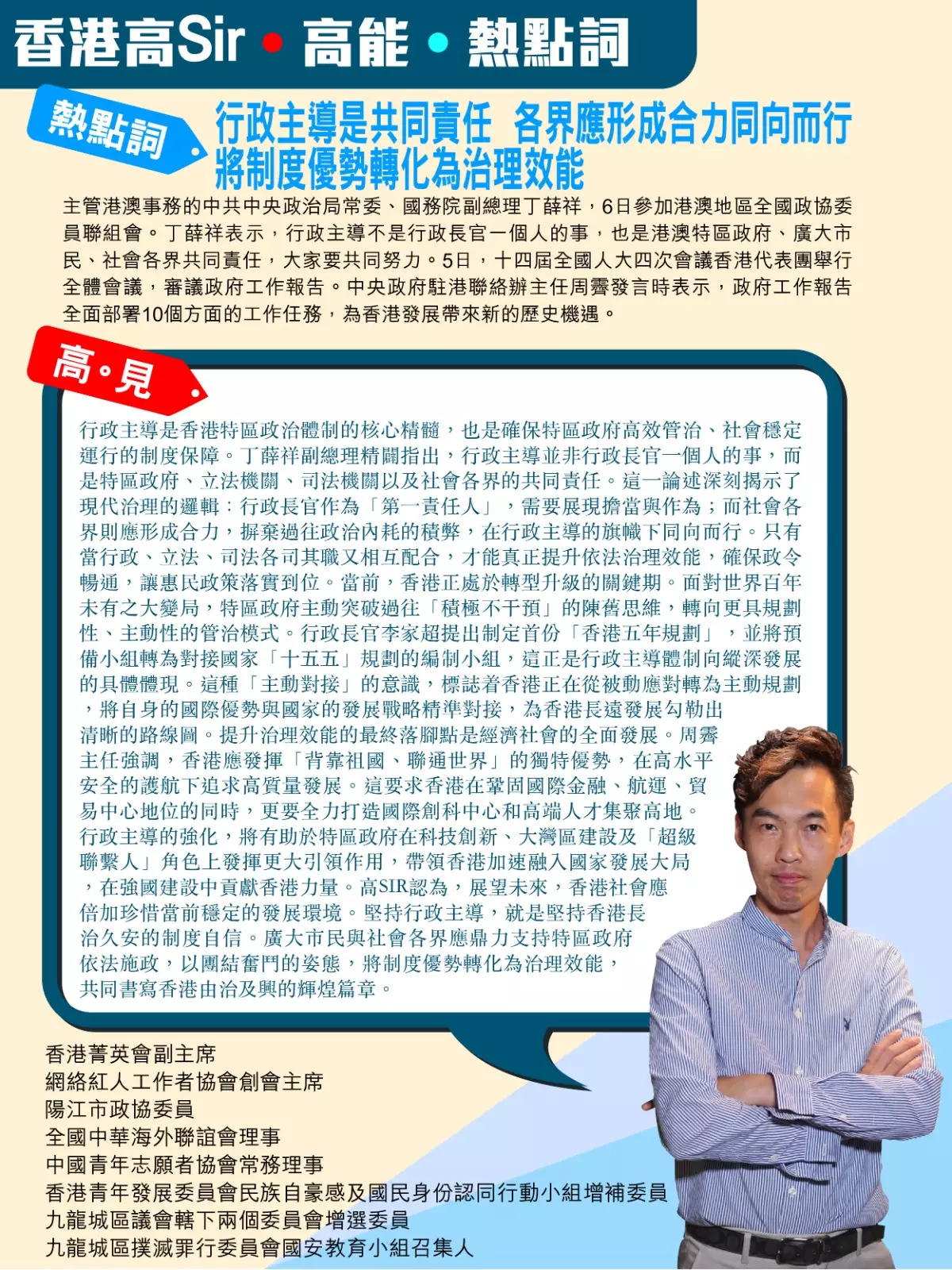
作者簡介:高松傑,人稱高Sir,男,香港建設力量KOL、時評人,大灣區創業者、灣區推介官、2023深圳十大好網民,工商管理碩士,本科修商業、公共及社會行政,多個平台均有文章及視頻專欄,發放愛國愛港正能量,講好中國故事及香港故事
香港再出發共同發起人、香港菁英會副主席、網絡紅人工作者協會創會主席、陽江市政協委員、全國中華海外聯誼會理事、中國青年志願者協會常務理事、河南省青聯港區常委、香港青年發展委員會民族自豪感及國民身份認同行動小組增補委員、第七屆九龍城區議會轄下地區設施及工程委員會和社區參與及文化康樂委員會增選委員、九龍城區撲滅罪行委員會國安教育小組召集人、家維關愛隊成員、地區國安導師
Western Media Lack the Vision to Understand China’s Strategic Choice to Move Beyond 5% GDP Growth
The Fourth Session of the 14th National People’s Congress has opened, with China setting its economic growth target at 4.5% to 5% for this year. As soon as the news came out, some Western media rushed to hype narratives like “failing to hit 5% for three straight years,” “economic slowdown,” and “lost momentum.” They oversimplify China’s economy with a single number and distort facts with prejudice. I cannot help but dismiss such outdated smears—they fool no one, and only lay bare their ignorance and arrogance toward China’s development logic. Facts speak louder than words: letting go of the 5% floor is not weakness, but strategic clarity; not retreat, but higher-quality progress.
This is no passive downward adjustment, but an active strategic choice—not a lack of growth momentum, but an inevitable shift toward high-quality development. Over the past three years, China has stuck to a growth target of around 5% and delivered on it last year, posting a solid performance amid global volatility. Setting a range target this year is a science-based decision weighing both domestic and international conditions: escalating geopolitical conflicts, rising trade protectionism, and persistent U.S. tariff pressures externally; and a critical phase of structural adjustment, momentum transition, and risk prevention domestically. A flexible range allows China to “aim high while standing firm,” reserving space for reform, transformation, and risk mitigation—a sign of mature governance, not the “inability to grow at 5%” claimed by Western media.
Western media excel at one trick: fixating on growth rates while ignoring economic scale; obsessing over figures while dismissing quality. Today, China’s economy exceeds 140 trillion yuan. At this massive base, 4.5% to 5% growth delivers an absolute incremental volume equivalent to the annual output of a mid-sized economy. As Professor Justin Yifu Lin noted, even at this target, China will still contribute roughly 30% of global growth—remaining the world’s top growth engine for more than a decade. It is blatant ideological bias and double standards to praise 1% to 2% growth in major Western economies as “strong recovery” while nitpicking China’s performance.
Ridiculously, Western media deliberately ignore a basic truth: China never chases growth for growth’s sake; development is ultimately for the people. This year’s Government Work Report keeps livelihood targets unwavering: over 12 million new urban jobs, a surveyed urban unemployment rate of around 5.5%, and CPI growth of about 2%. Fiscal policy will be more proactive and impactful, with a deficit rate of around 4%, 1.3 trillion yuan in ultra-long special government bonds, and general public budget expenditure exceeding 30 trillion yuan for the first time—focused on major national projects, new-type infrastructure, new urbanization, and livelihood security. Governments at all levels practice strict frugality to spend every penny on key development areas and urgent livelihood needs. Western media will never understand, nor admit, this people-centered development logic.
They dare not tell the public: behind the mild growth adjustment is a surge in development quality. This year’s report mentions “technology” 33 times, “innovation” 36 times, and “artificial intelligence” 7 times, outlining plans for brain-computer interfaces, intelligent agents, and future industries to build a new pattern of smart economy. China’s economy is shifting from quantity-driven to quality-driven, from factor-driven to innovation-driven. GDP growth no longer dominates all goals; instead, priorities are industrial upgrading, sci-tech self-reliance, green transition, and better livelihoods. This strategic commitment to long-term sustainability over short-term figures is the secret to China’s economic resilience.
Figures including Henry Tang, Member of the Standing Committee of the National Committee of the Chinese People’s Political Consultative Conference, and Wang Dongsheng, CPPCC Member, have stated that amid complex conditions and a huge economic base, the 4.5%–5% target is pragmatic, reasonable, and highly meaningful. It is not conservatism, but clarity; not retreat, but building momentum. The report stresses “striving for better results in actual work”—a powerful response: we hold the bottom line steady and can unlock full potential, with growth poised to exceed the upper bound of the range.
For years, Western public opinion has followed the same playbook to smear China’s economy: when it grows fast, it’s a “threat”; when it adjusts, it’s a “collapse”; when figures are high, they hype “debt bubbles”; when targets are calibrated, they hype “stalled recovery.” They refuse to recognize China’s strong economic resilience, the vibrant rise of new quality productive forces, and the path of Chinese-style modernization. For decades, “China collapse” theories have collapsed repeatedly, rooted in a persistent Western-centric bias that misreads a major country with 1.4 billion people, a super-large market, and a complete industrial system.
To judge an economy, we should look beyond short-term growth rates—to stable employment, rising incomes, improved livelihoods, and sustainable prospects. This year, China will expand domestic demand and boost consumption; ramp up R&D to break bottleneck technologies; deepen reform and opening-up and improve the business environment; coordinate development and security to guard against systemic risks. We prepare for the worst while striving for the best—this is not passive response, but proactive leadership.
Toward the 2035 vision, China aims to double per capita GDP from 2020 levels and join the ranks of moderately developed countries. The next decade is critical to overcoming the middle-income trap. What we need is not extensive fast growth, but higher-quality, more efficient, more sustainable, and more secure development. The 4.5%–5% target aligns with long-term potential and long-range plans—a realistic, science-based pathway.
China’s economic ship will never be diverted by noisy narratives from foreign media. We reject indiscriminate stimulus, false prosperity, and over-reliance on a single metric. We stay grounded, seek progress while maintaining stability, focus on high-quality development, and serve people’s better lives. Despite external skepticism and smears, the fundamentals of China’s long-term economic improvement remain unchanged; its super-large market advantage stays intact; and supporting factors—complete industrial system, abundant human resources, and ongoing reform dividends—are solid.
Facts will prove once again: slowing down strategically is to accelerate better; pausing to gather strength is to run farther. Voices determined to discredit China will eventually be drowned out by China’s solid progress. China’s economic future is in its own hands, with bright prospects and great promise. I firmly believe that under the strong leadership of the central government and with the concerted efforts of all Chinese people, the 15th Five-Year Plan will be fully delivered, and China’s economy will keep growing stronger.
Jacky Chung Kit Jacky(HK Ko Sir)


/wp-content/uploads/blogger/2025/11/MEITU_20251105_1342594484-225x300.jpg.webp)
