《香港高Sir•高能•熱點詞》
2025.03.15
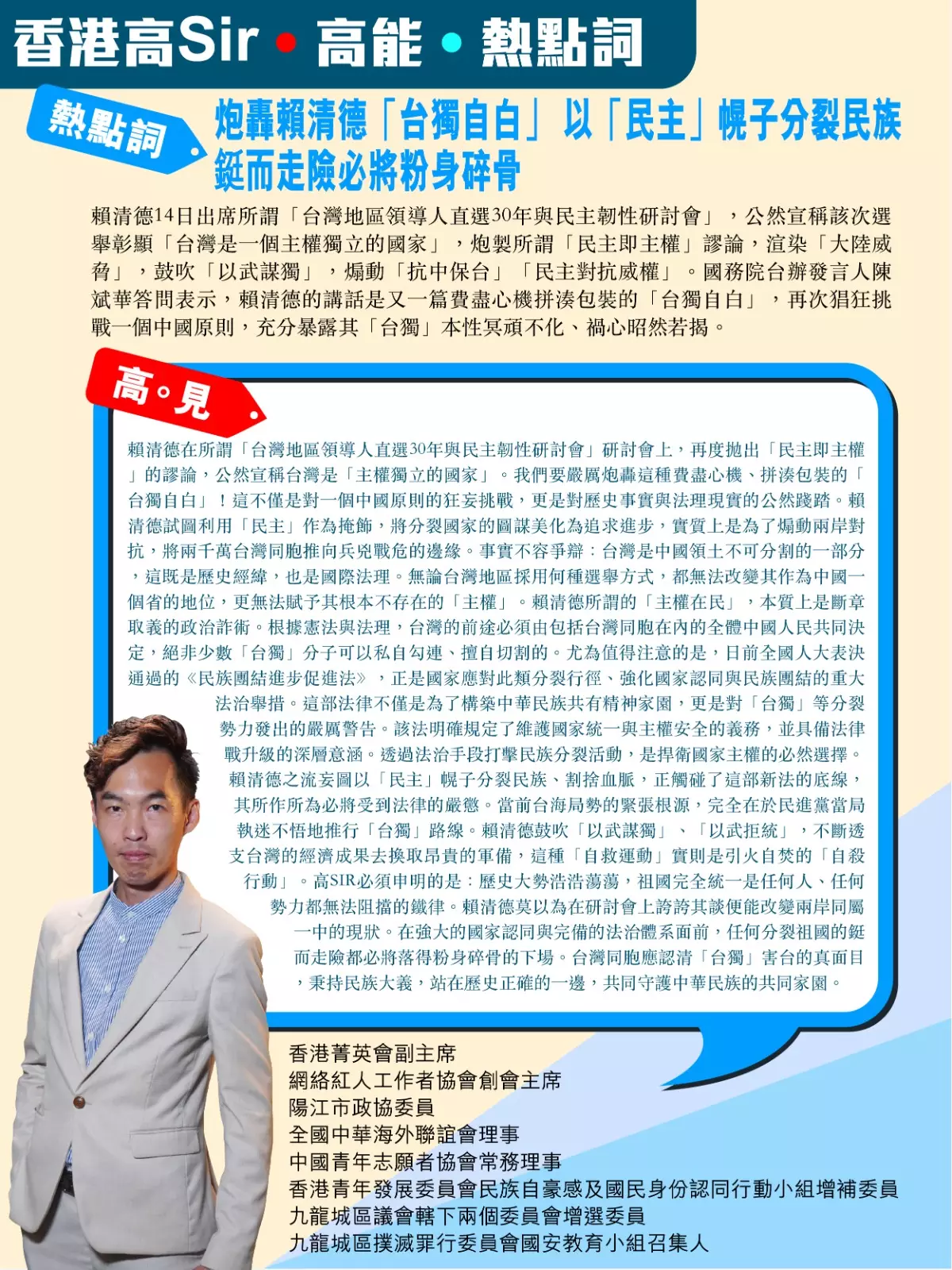
熱點詞:炮轟賴清德「台獨自白」 以「民主」幌子分裂民族 鋌而走險必將粉身碎骨
賴清德14日出席所謂「台灣地區領導人直選30年與民主韌性研討會」,公然宣稱該次選舉彰顯「台灣是一個主權獨立的國家」,炮製所謂「民主即主權」謬論,渲染「大陸威脅」,鼓吹「以武謀獨」,煽動「抗中保台」「民主對抗威權」。國務院台辦發言人陳斌華答問表示,賴清德的講話是又一篇費盡心機拼湊包裝的「台獨自白」,再次猖狂挑戰一個中國原則,充分暴露其「台獨」本性冥頑不化、禍心昭然若揭。
熱點詞:賴清德在所謂「台灣地區領導人直選30年與民主韌性研討會」研討會上,再度拋出「民主即主權」的謬論,公然宣稱台灣是「主權獨立的國家」。我們要嚴厲炮轟這種費盡心機、拼湊包裝的「台獨自白」!這不僅是對一個中國原則的狂妄挑戰,更是對歷史事實與法理現實的公然踐踏。賴清德試圖利用「民主」作為掩飾,將分裂國家的圖謀美化為追求進步,實質上是為了煽動兩岸對抗,將兩千萬台灣同胞推向兵兇戰危的邊緣。事實不容爭辯:台灣是中國領土不可分割的一部分,這既是歷史經緯,也是國際法理。無論台灣地區採用何種選舉方式,都無法改變其作為中國一個省的地位,更無法賦予其根本不存在的「主權」。賴清德所謂的「主權在民」,本質上是斷章取義的政治詐術。根據憲法與法理,台灣的前途必須由包括台灣同胞在內的全體中國人民共同決定,絕非少數「台獨」分子可以私自勾連、擅自切割的。尤為值得注意的是,日前全國人大表決通過的《民族團結進步促進法》,正是國家應對此類分裂行徑、強化國家認同與民族團結的重大法治舉措。這部法律不僅是為了構築中華民族共有精神家園,更是對「台獨」等分裂勢力發出的嚴厲警告。該法明確規定了維護國家統一與主權安全的義務,並具備法律戰升級的深層意涵。透過法治手段打擊民族分裂活動,是捍衛國家主權的必然選擇。賴清德之流妄圖以「民主」幌子分裂民族、割捨血脈,正觸碰了這部新法的底線,其所作所為必將受到法律的嚴懲。當前台海局勢的緊張根源,完全在於民進黨當局執迷不悟地推行「台獨」路線。賴清德鼓吹「以武謀獨」、「以武拒統」,不斷透支台灣的經濟成果去換取昂貴的軍備,這種「自救運動」實則是引火自焚的「自殺行動」。高SIR必須申明的是:歷史大勢浩浩蕩蕩,祖國完全統一是任何人、任何勢力都無法阻擋的鐵律。賴清德莫以為在研討會上誇誇其談便能改變兩岸同屬一中的現狀。在強大的國家認同與完備的法治體系面前,任何分裂祖國的鋌而走險都必將落得粉身碎骨的下場。台灣同胞應認清「台獨」害台的真面目,秉持民族大義,站在歷史正確的一邊,共同守護中華民族的共同家園。
Condemning Lai Ching-te’s "Independence Confession": Splitting the Nation Under the Pretense of Democracy Will Only Lead to Utter Ruin
On March 14, Lai Ching-te attended the so-called "Symposium on 30 Years of Direct Election for Taiwan’s Leader and Democratic Resilience". He blatantly claimed the election proved "Taiwan is a sovereign independent country", concocted the fallacy of "democracy equals sovereignty", hyped the "mainland threat", advocated "seeking independence by force", and incited "opposing China to protect Taiwan" and "democracy against authoritarianism". Spokesperson Chen Binhua of the Taiwan Affairs Office of the State Council stated that Lai’s speech is another elaborately packaged "independence confession", a reckless challenge to the one-China principle, fully exposing his obstinate "Taiwan independence" nature.
We sternly condemn this deceitful "independence confession". It is an arrogant violation of the one-China principle and a blatant trampling on historical and legal facts. Lai hides behind "democracy" to whitewash separatist schemes, stoke cross-Strait confrontation, and push 23 million Taiwan compatriots to the brink of war. Facts are indisputable: Taiwan is an inalienable part of China’s territory, rooted in history and enshrined in international law. No electoral method in Taiwan can alter its status as a province of China, nor grant it non-existent "sovereignty".
Lai’s distorted "popular sovereignty" is a political trick. Legally, the future of Taiwan must be decided by all Chinese people, including Taiwan compatriots, never by a handful of separatists. Notably, the newly adopted Law on the Promotion of Ethnic Unity and Progress by the National People’s Congress is a critical legal measure to counter separatism, safeguard national unity, and warn "Taiwan independence" forces. It imposes clear obligations to defend national sovereignty and territorial integrity, serving as a powerful legal weapon against separatist acts.
The root cause of cross-Strait tensions lies in the DPP authorities’ stubborn "Taiwan independence" path. Lai’s advocacy of "seeking independence by force" squanders Taiwan’s resources on expensive armaments, a suicidal act that endangers peace. The historical trend toward complete national reunification is irresistible. Any reckless attempt to split the motherland will end in total destruction. Taiwan compatriots must see through the harm of "Taiwan independence", uphold national righteousness, stand on the right side of history, and safeguard the shared homeland of the Chinese nation.
高Sir正能量
** 博客文章文責自負,不代表本公司立場 **
文章:中東衝突引爆三去浪潮!單極霸權走向終結,香港將成全球資金最終避風港

當美以戰機劃破波斯灣夜空,這場軍事行動絕非單純的地緣衝突,而是推動全球去美元化、去美債化、去美軍化的關鍵催化劑,更徹底攪動中東財富版圖,為香港帶來歷史性的資金承接機遇。這場衝突不僅加劇地區動盪,更激化全球對單極霸權的反思,加速國際秩序由「美國獨大」邁向「多極共治」,並重塑全球資金流動格局。
去美元化:石油美元根基崩塌,貨幣體系重構提速
美以對伊朗的軍事打擊,直接動搖美元霸權的核心支柱——石油美元體系。長期以來,「石油‑美元」綁定支撐美元的全球主導地位,而這場衝突讓世界清楚認知:美元早已成為美國推行霸權的政治工具。
衝突爆發後,伊朗率先實現對華原油貿易100%人民幣結算,雙邊經貿人民幣使用比例飆升至86%,徹底繞開美元體系。霍爾木茲海峽作為全球20%石油貿易的咽喉要道,因戰事面臨中斷風險,迫使沙特、伊拉克、阿聯酋等產油國加速接入CIPS系統,擴大人民幣結算規模。目前,中東原油人民幣結算佔比已突破41%,美元在能源貿易中的份額驟降至52%。
全球央行動作更具指標意義:截至2026年3月,美元在全球外匯儲備中佔比跌至56.9%,創1995年以來新低;中國連續15個月減持美債,持倉規模降至6826億美元,較峰值近乎腰斬。與此同時,全球央行持續大幅增持黃金,黃金儲備佔比29年來首次超越美債,成為抵禦美元風險的核心資產。全球已達成共識:去美元化不是選擇,而是自保。
去美債化:避險光環徹底破碎,資產配置加速分流
過去地緣衝突爆發時,「危機買美債」是全球資金的慣性選擇,但美以行動徹底打破這一邏輯。戰爭引發油價飆升、通脹預期升溫,推動10年期美債收益率由衝突前的3.96%升至4.14%,美債價格隨之下跌,傳統避險屬性完全失效。
美國財政狀況更是岌岌可危:聯邦債務總規模突破38.88萬億美元,債務佔GDP比重高達127%,遠超安全警戒線;年度利息支出達1.12萬億美元,首次超過軍費開支,「借新還舊」模式已難以為繼。美國將美債武器化的行徑,令各國高度警惕,伊朗更公開警告「投資美債等同資助戰爭」,直接引發全球投資者撤離。
全球資產配置迎來結構性轉變:歐洲機構大幅減持美債,瑞典養老基金減持70%,丹麥基金全數清倉;中東產油國由增持轉為觀望,資金轉向人民幣資產、黃金與歐洲主權債券。美債從「全球必配資產」淪為「可選配置」,海外持有比例已跌破25%安全線。
去美軍化:從安全依賴到戰略自主,全球軍事格局重塑
美以入侵伊朗,徹底撕碎美國「全球安全守護者」的標籤,暴露其軍事霸權的脆弱性,推動全球進入去美軍化新階段。伊朗在反擊中明確提出「美軍全面撤出中東、關閉所有軍事基地」的目標,而中東國家對美國的安全信任早已崩塌。
伊拉克已宣布2026年底前驅逐所有美軍,科威特、巴林等國相繼要求美軍縮減駐紮規模;美國被迫從亞太抽調防空系統增援中東,顯現全球兵力不足的窘境。歐洲盟友拒絕參戰,與美國戰略切割;日韓等亞太國家亦加速推進戰略自主,不再盲目跟隨美國軍事行動。
美國正由「全球警察」淪為「區域強權」:中東駐軍被迫收縮,影響力大幅下滑;多處軍事基地遭伊朗精確打擊,指揮體系受損、人員傷亡增加,戰略成本遠超預期。世界各國逐漸認清:擺脫對美軍依賴,才是長久安全之道,多極軍事格局正在加速成型。
中東財富大遷徙:杜拜避險光環褪色,資金加速湧入香港
中東局勢持續升級,向來被視為全球資金避風港的杜拜,正面臨前所未有的考驗。擔心地區動盪波及資產安全,眾多亞洲富豪家族紛紛推遲遷入計劃,減持當地資產,重新考慮將資金轉移至香港或新加坡。
數據印證,香港已成為中東避險資金的核心選擇。香港金融學院報告顯示,91%受訪家族辦公室已在香港布局,未來三年計劃在港投資風險資產的家辦比例,將由54%升至78%。特區政府三年吸引200間家族辦公室的目標,早在2025年8月便已提前達成,目前香港單一家辦數量已突破3380間。
香港的優勢獨一無二:作為全球超高淨值人士第二大聚集地,股市規模與流動性領先亞洲;憑藉滬深港通、債券通、跨境理財通,成為連接國際與中國內地市場的唯一關鍵樞紐;簡單稅制、頂級專業服務,疊加上市制度改革、數字經濟、綠色金融、藝術品交易等新領域全面發展,讓香港持續保持核心競爭力。
2026年3月初伊朗局勢惡化之際,香港雖與伊朗直接貿易規模極小,卻憑藉自由港與國際金融安全港的優勢,吸引大量中東資金流入,帶動資金加速配置港元與人民幣資產,特區政府亦已做好預案,應對潛在金融波動。
戰後啟示:單極霸權終結,東升西降格局確立
美以入侵伊朗,本質是美國霸權的自我消耗。這場戰爭不僅未能鞏固美國地位,反而成為去美元、去美債、去美軍化的加速閥,同時徹底改寫中東財富流向,驅動全球資本向安全、穩定、多元的體系集聚。
短期內,全球將迎來劇烈的去化與資金重配:美債收益率維持高位,海外持倉持續減少,美元儲備佔比跌破55%;中東美軍加速收縮,地區國家加快戰略自主;能源貿易本幣化提速,石油美元體系徹底動搖;杜拜吸引力下滑,中東與亞洲資金大舉流入香港,人民幣與港元資產迎來歷史性配置機遇。
長期而言,單極格局徹底終結,多極時代全面來臨:美元依舊存在,但主導權大幅削弱,形成美元、人民幣、歐元並行的多元貨幣體系;美債規模仍居全球首位,但海外佔比將跌破20%;美軍全球部署持續收縮,中俄、沙特、土耳其等成為地區安全核心力量;全球資金更趨理性,香港憑藉獨特優勢,成為中東財富外溢與全球高淨值資產的核心承載地,人民幣資產國際地位持續提升。
這場衝突清晰證明:霸權擴張終無出路,合作共贏才是時代大勢。去美元、去美債、去美軍化的浪潮不可逆轉,單極霸權正加速走向終結。中東衝突過後,美國實力將進一步急速衰落,東升西降的國際格局更為凸顯,中國全球影響力持續擴大,香港作為國際金融中心的地位,亦將迎來全方位提升。
作者簡介:高松傑,人稱高Sir,男,香港建設力量KOL、時評人,大灣區創業者、灣區推介官、2023深圳十大好網民,工商管理碩士,本科修商業、公共及社會行政,多個平台均有文章及視頻專欄,發放愛國愛港正能量,講好中國故事及香港故事
香港再出發共同發起人、香港菁英會副主席、網絡紅人工作者協會創會主席、陽江市政協委員、全國中華海外聯誼會理事、中國青年志願者協會常務理事、河南省青聯港區常委、香港青年發展委員會民族自豪感及國民身份認同行動小組增補委員、第七屆九龍城區議會轄下地區設施及工程委員會和社區參與及文化康樂委員會增選委員、九龍城區撲滅罪行委員會國安教育小組召集人、家維關愛隊成員、地區國安導師
U.S.-Israel Strike on Iran Triggers Triple De-Americanization Wave
Unipolar Hegemony Collapses, Hong Kong Emerges as Global Capital’s Ultimate Safe Haven
As U.S. and Israeli warplanes tear through the night sky over the Persian Gulf, this military operation is far more than a mere geopolitical conflict. It serves as a critical catalyst accelerating global de-dollarization, de-American debtization, and de-U.S. militarization, while completely reshaping the Middle East’s wealth landscape and presenting Hong Kong with a historic opportunity to absorb massive capital inflows. The conflict not only fuels regional turmoil but also intensifies global skepticism toward unipolar hegemony, speeding up the shift of the international order from U.S. dominance to multipolar co-governance, and restructuring global capital flows.
De-Dollarization: The Petro-Dollar System Crumbles, Global Monetary Order Rebuilt
The U.S.-Israel military offensive against Iran has directly struck at the core pillar of dollar dominance — the petro-dollar system. For decades, the oil-dollar linkage underpinned the greenback’s global supremacy. This conflict has laid bare a harsh reality: the dollar has long been weaponized as a tool of U.S. hegemony.
Since the outbreak of hostilities, Iran has fully adopted RMB settlement for 100% of its crude oil trade with China, with the RMB share in bilateral trade surging to 86%, completely bypassing the dollar system. The Strait of Hormuz, through which 20% of global oil trade passes, faces disruption risks, forcing Saudi Arabia, Iraq, the UAE, and other oil producers to accelerate access to the CIPS system and expand RMB settlement. At present, RMB settlement for Middle Eastern crude oil has exceeded 41%, while the dollar’s share in energy trade has plummeted to 52%.
Global central bank actions send a strong signal: as of March 2026, the U.S. dollar accounted for just 56.9% of global foreign exchange reserves — the lowest level since 1995. China has cut its holdings of U.S. Treasuries for 15 consecutive months, down to $682.6 billion, nearly halved from its peak. Meanwhile, central banks worldwide are aggressively buying gold, whose share in reserves has surpassed U.S. debt for the first time in 29 years, becoming the primary hedge against dollar risks. The global consensus is clear: de-dollarization is not a choice, but a necessity for self-preservation.
De-American Debtization: Safe-Haven Myth Shattered, Asset Allocation Diverges Sharply
In past geopolitical crises, “buy U.S. Treasuries in turmoil” was the default global strategy. The U.S.-Israel attack on Iran has broken this logic completely. The war sent oil prices soaring and inflation expectations rising, pushing the 10-year U.S. Treasury yield from 3.96% to 4.14%, depressing bond prices and invalidating their traditional safe-haven role.
America’s fiscal health is in critical condition: federal debt has surpassed $38.88 trillion, with a debt-to-GDP ratio of 127%, far above the safety threshold. Annual interest payments hit $1.12 trillion, exceeding military spending for the first time, making the “borrow-to-repay” model unsustainable. The weaponization of U.S. debt has alarmed nations worldwide; Iran publicly warned that “investing in U.S. debt equals funding war,” triggering a global investor exodus.
A structural shift in global asset allocation is underway: European institutions are slashing U.S. debt — Sweden’s pension fund cut holdings by 70%, Denmark’s funds fully liquidated. Middle East oil producers have turned from buyers to spectators, redirecting capital into RMB assets, gold, and European sovereign bonds. U.S. Treasuries have fallen from a “must-have global asset” to an “optional one,” with foreign ownership falling below the 25% safety line.
De-U.S. Militarization: From Security Dependence to Strategic Autonomy, Global Military Order Remade
The U.S.-Israel invasion of Iran has torn apart America’s facade as the “global security guardian,” exposing the fragility of its military hegemony and pushing the world into a new era of de-U.S. militarization. In its counterattack, Iran has demanded the full withdrawal of U.S. troops and closure of all military bases in the Middle East — a call echoed by regional states that have lost all trust in U.S. security commitments.
Iraq has announced it will expel all U.S. forces by the end of 2026; Kuwait, Bahrain, and others are demanding cuts to U.S. troop levels. The U.S. has been forced to redeploy air defense systems from the Asia-Pacific to the Middle East, revealing its global overstretch. European allies refused to join the war, strategically distancing themselves from Washington; Japan, South Korea, and other Asian partners are also accelerating strategic autonomy, no longer blindly following U.S. military moves.
The U.S. is declining from a “global policeman” to a “regional power.” Its military footprint in the Middle East is shrinking, influence collapsing. Several bases have been hit by precise Iranian strikes, with command systems damaged and casualties mounting — strategic costs far exceeding expectations. Nations now understand: true long-term security comes from ending reliance on U.S. military power, as a multipolar military order takes shape.
Middle Eastern Wealth Migration: Dubai Fades, Capital Floods Into Hong Kong
As Middle East tensions escalate, Dubai — long seen as a global safe haven — is facing an unprecedented crisis. Fearing spillover instability, wealthy Asian families are delaying relocation plans, selling local assets, and reallocating capital to Hong Kong or Singapore.
Data confirms Hong Kong has become the top destination for Middle Eastern safe-haven capital. A Hong Kong Institute of Finance report shows 91% of surveyed family offices have established a presence in Hong Kong. The share planning to invest in risky assets in the city will rise from 54% to 78% over the next three years. The government’s three-year target of attracting 200 family offices was achieved as early as August 2025; the number of single-family offices in Hong Kong now exceeds 3,380.
Hong Kong’s advantages are irreplaceable: it ranks second globally for ultra-high-net-worth individuals, with leading stock market size and liquidity in Asia. Through Stock Connect, Bond Connect, and Wealth Connect, it is the only critical bridge linking global and mainland Chinese markets. Its simple tax system, world-class professional services, plus reforms in listing rules, digital economy, green finance, and art trading, cement its core competitiveness.
In early March 2026, as Iran tensions flared, Hong Kong — despite minimal direct trade with Iran — attracted massive Middle Eastern capital thanks to its free port and international financial safe-haven status, driving strong inflows into HKD and RMB assets. The HKSAR has prepared contingency plans to manage potential financial volatility.
Post-Conflict Implications: Unipolar Hegemony Ends, the East Rises as the West Declines
The U.S.-Israel attack on Iran is, in essence, self-consumption of American hegemony. Far from consolidating U.S. power, it has turbocharged de-dollarization, de-American debtization, and de-U.S. militarization, while completely redirecting Middle Eastern wealth toward stable, secure, and diversified systems.
In the short term, the world will see an intense wave of restructuring: U.S. Treasury yields stay high, foreign holdings shrink further, dollar reserves fall below 55%; U.S. troops in the Middle East retreat rapidly, regional states advance autonomy; local currency settlement in energy trade accelerates, the petro-dollar system is fatally weakened; Dubai’s appeal fades, and Middle Eastern & Asian capital pours into Hong Kong, presenting a historic opportunity for RMB and HKD assets.
In the long run, unipolarity is finished, and a genuine multipolar era has arrived. The dollar will survive but with greatly diminished influence, alongside the RMB and Euro in a diversified monetary system. U.S. debt will remain large, but foreign ownership will drop below 20%. U.S. global military deployment will continue contracting, with China, Russia, Saudi Arabia, and Turkey emerging as regional security anchors.
Global capital will grow more rational. With its unique strengths, Hong Kong will become the core hub for Middle Eastern wealth spillover and global high-net-worth asset allocation, while the international status of RMB assets continues to rise.
This conflict proves beyond doubt: hegemonic expansion is a dead end. Win-win cooperation is the irresistible trend of our time. The wave of de-dollarization, de-American debtization, and de-U.S. militarization is irreversible, and unipolar hegemony is in terminal decline.
In the aftermath of the Middle East conflict, U.S. power will decline further, the pattern of the East rising and the West falling will become more pronounced, China’s global influence will expand, and Hong Kong’s status as an international financial center will rise comprehensively.
Jacky Chung Kit Ko (HK Ko Sir)