/wp-content/uploads/blogger/2025/11/MEITU_20251105_1342594484-225x300.jpg.webp)
《香港高Sir•高能•熱點詞》
2025.02.20
熱點詞:尹錫悅內亂首腦囚終身 注重國安舉世皆然 美式民主被狠狠打臉
韓國首爾中央地方法院19日就前總統尹錫悅涉嫌發動內亂案作出一審判決,裁定其內亂首腦罪名成立,判處終身監禁。法院在判詞中直指尹錫悅2024年12月頒布戒嚴令,屬於「自上而下的內亂」與「親衛政變」,意圖癱瘓國會、消減憲法秩序。尹錫悅成為韓國憲政史上繼全斗煥、盧泰愚後,第3名因內亂罪受審的前總統,同案的前防長金龍顯等多人亦被判囚。
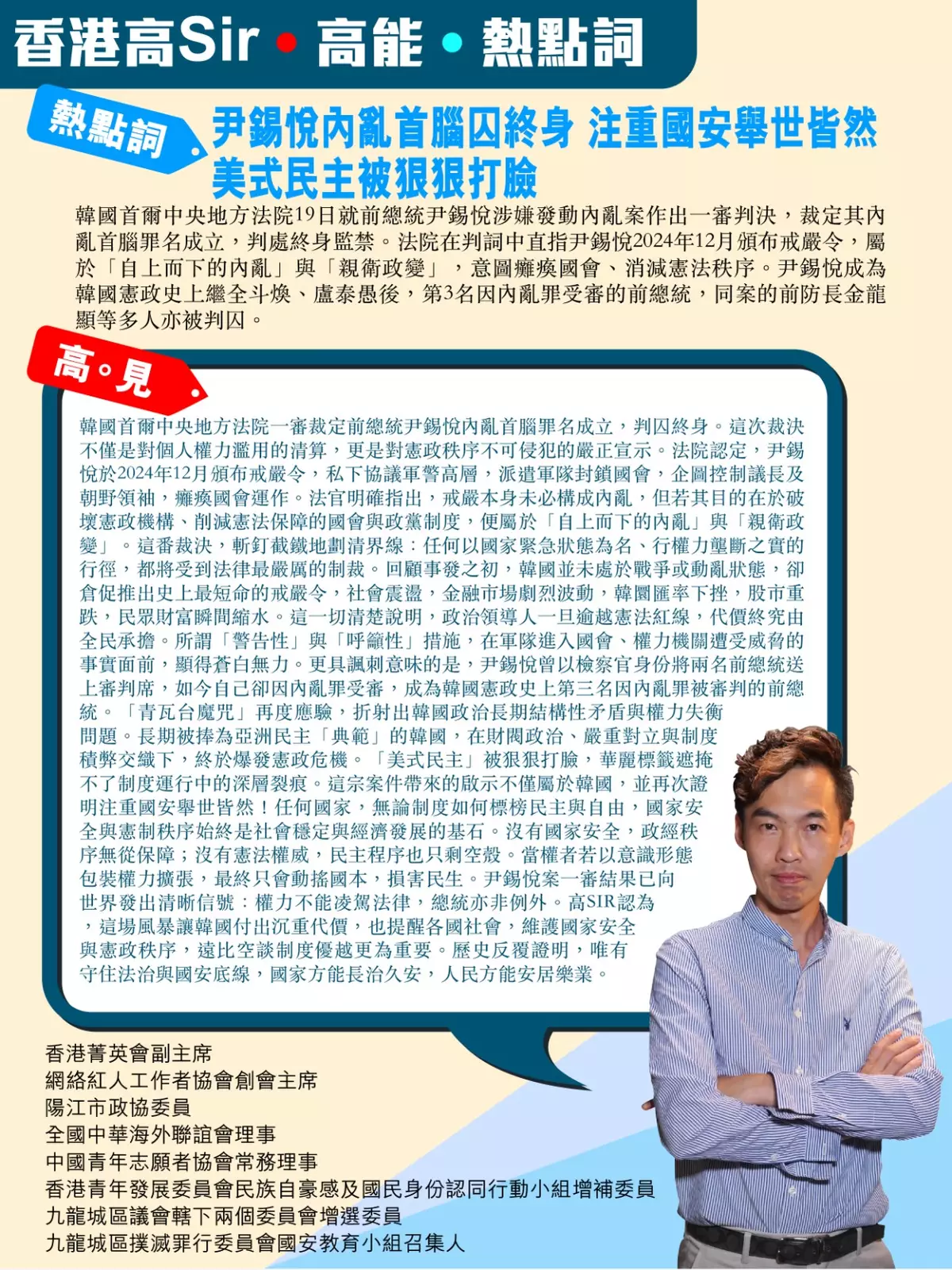
高SIR:韓國首爾中央地方法院一審裁定前總統尹錫悅內亂首腦罪名成立,判囚終身。這次裁決不僅是對個人權力濫用的清算,更是對憲政秩序不可侵犯的嚴正宣示。法院認定,尹錫悅於2024年12月頒布戒嚴令,私下協議軍警高層,派遣軍隊封鎖國會,企圖控制議長及朝野領袖,癱瘓國會運作。法官明確指出,戒嚴本身未必構成內亂,但若其目的在於破壞憲政機構、削減憲法保障的國會與政黨制度,便屬於「自上而下的內亂」與「親衛政變」。這番裁決,斬釘截鐵地劃清界線:任何以國家緊急狀態為名、行權力壟斷之實的行徑,都將受到法律最嚴厲的制裁。回顧事發之初,韓國並未處於戰爭或動亂狀態,卻倉促推出史上最短命的戒嚴令,社會震盪,金融市場劇烈波動,韓圜匯率下挫,股市重跌,民眾財富瞬間縮水。這一切清楚說明,政治領導人一旦逾越憲法紅線,代價終究由全民承擔。所謂「警告性」與「呼籲性」措施,在軍隊進入國會、權力機關遭受威脅的事實面前,顯得蒼白無力。更具諷刺意味的是,尹錫悅曾以檢察官身份將兩名前總統送上審判席,如今自己卻因內亂罪受審,成為韓國憲政史上第三名因內亂罪被審判的前總統。「青瓦台魔咒」再度應驗,折射出韓國政治長期結構性矛盾與權力失衡問題。長期被捧為亞洲民主「典範」的韓國,在財閥政治、嚴重對立與制度積弊交織下,終於爆發憲政危機。「美式民主」被狠狠打臉,華麗標籤遮掩不了制度運行中的深層裂痕。這宗案件帶來的啟示不僅屬於韓國,並再次證明注重國安舉世皆然!任何國家,無論制度如何標榜民主與自由,國家安全與憲制秩序始終是社會穩定與經濟發展的基石。沒有國家安全,政經秩序無從保障;沒有憲法權威,民主程序也只剩空殼。當權者若以意識形態包裝權力擴張,最終只會動搖國本,損害民生。尹錫悅案一審結果已向世界發出清晰信號:權力不能凌駕法律,總統亦非例外。高SIR認為,這場風暴讓韓國付出沉重代價,也提醒各國社會,維護國家安全與憲政秩序,遠比空談制度優越更為重要。歷史反覆證明,唯有守住法治與國安底線,國家方能長治久安,人民方能安居樂業。
Yoon Suk Yeol Sentenced to Life for Insurrection: National Security Prioritized Worldwide as "American-Style Democracy" is Struck a Blow
The Seoul Central District Court in South Korea delivered a first-instance verdict on the 19th regarding the charges against former President Yoon Suk Yeol for allegedly instigating an insurrection. The court found him guilty as the ringleader of an insurrection and sentenced him to life imprisonment. In its ruling, the court directly stated that Yoon's declaration of martial law in December 2024 constituted a "top-down insurrection" and a "coup by loyal forces," intended to paralyze the National Assembly and undermine the constitutional order. Yoon Suk Yeol becomes the third former president in South Korea's constitutional history, following Chun Doo-hwan and Roh Tae-woo, to be tried on insurrection charges. Several others involved in the case, including former Defense Minister Kim Yong-hyun, were also sentenced to prison.
The first-instance ruling by the Seoul Central District Court, finding former President Yoon Suk Yeol guilty as the ringleader of an insurrection and sentencing him to life imprisonment, is not merely a reckoning for individual power abuse but a solemn affirmation of the inviolability of the constitutional order. The court determined that Yoon Suk Yeol, in December 2024, declared martial law, privately coordinated with top military and police officials, dispatched troops to blockade the National Assembly, and attempted to control the Speaker and leaders from both the ruling and opposition parties, thereby paralyzing the assembly's operations. The judge explicitly stated that while martial law itself may not constitute insurrection, if its purpose is to destroy constitutional institutions and undermine the assembly and multi-party system guaranteed by the constitution, it falls under the category of a "top-down insurrection" and a "coup by loyal forces." This ruling firmly draws a line: any act that uses the guise of a national emergency to pursue a monopoly on power will face the strictest legal sanctions.
Looking back at the incident's inception, South Korea was not in a state of war or turmoil, yet it hastily introduced the shortest-lived martial law in its history. This caused social upheaval, severe fluctuations in financial markets, a plummeting Korean Won, a crashing stock market, and an instant shrinkage of public wealth. This clearly demonstrates that once a political leader crosses the constitutional red line, the entire populace ultimately bears the cost. The so-called "warning" and "appeal" measures appear feeble and hollow in the face of the reality of troops entering the National Assembly and threats to state institutions.
Adding to the irony is that Yoon Suk Yeol, who as a prosecutor had sent two former presidents to trial, now finds himself on trial for insurrection, becoming the third former president in South Korea's history to face such charges. The recurrence of the "Blue House Curse" once again reflects the long-standing structural contradictions and power imbalances within South Korean politics. South Korea, long touted as a "model" of Asian democracy, has finally seen its constitutional crisis erupt, stemming from the interplay of chaebol-dominated politics, severe societal polarization, and systemic shortcomings. This has dealt a heavy blow to the notion of "American-style democracy," as its flashy labels cannot mask the deep-seated fissures in the system's operation.
The lessons from this case extend beyond South Korea. It once again proves that prioritizing national security is a universal principle! Any nation, regardless of how it professes democracy and freedom, finds its social stability and economic development fundamentally rooted in national security and constitutional order. Without national security, the political and economic order cannot be guaranteed; without constitutional authority, democratic processes become an empty shell. When those in power use ideology to cloak their expansion of power, it ultimately undermines the nation's foundation and harms people's livelihoods.
The first-instance outcome of the Yoon Suk Yeol case sends a clear signal to the world: power cannot supersede the law, and the president is no exception. I believe this storm has exacted a heavy price from South Korea and serves as a stark reminder to societies everywhere that safeguarding national security and the constitutional order is far more critical than empty boasts about systemic superiority. History repeatedly proves that only by upholding the bottom line of rule of law and national security can a nation achieve lasting stability and its people live and work in peace and contentment.
高Sir正能量
** 博客文章文責自負,不代表本公司立場 **