/wp-content/uploads/blogger/2025/11/MEITU_20251105_1342594484-225x300.jpg.webp)
《香港高Sir•高能•熱點詞》
2026.04.01
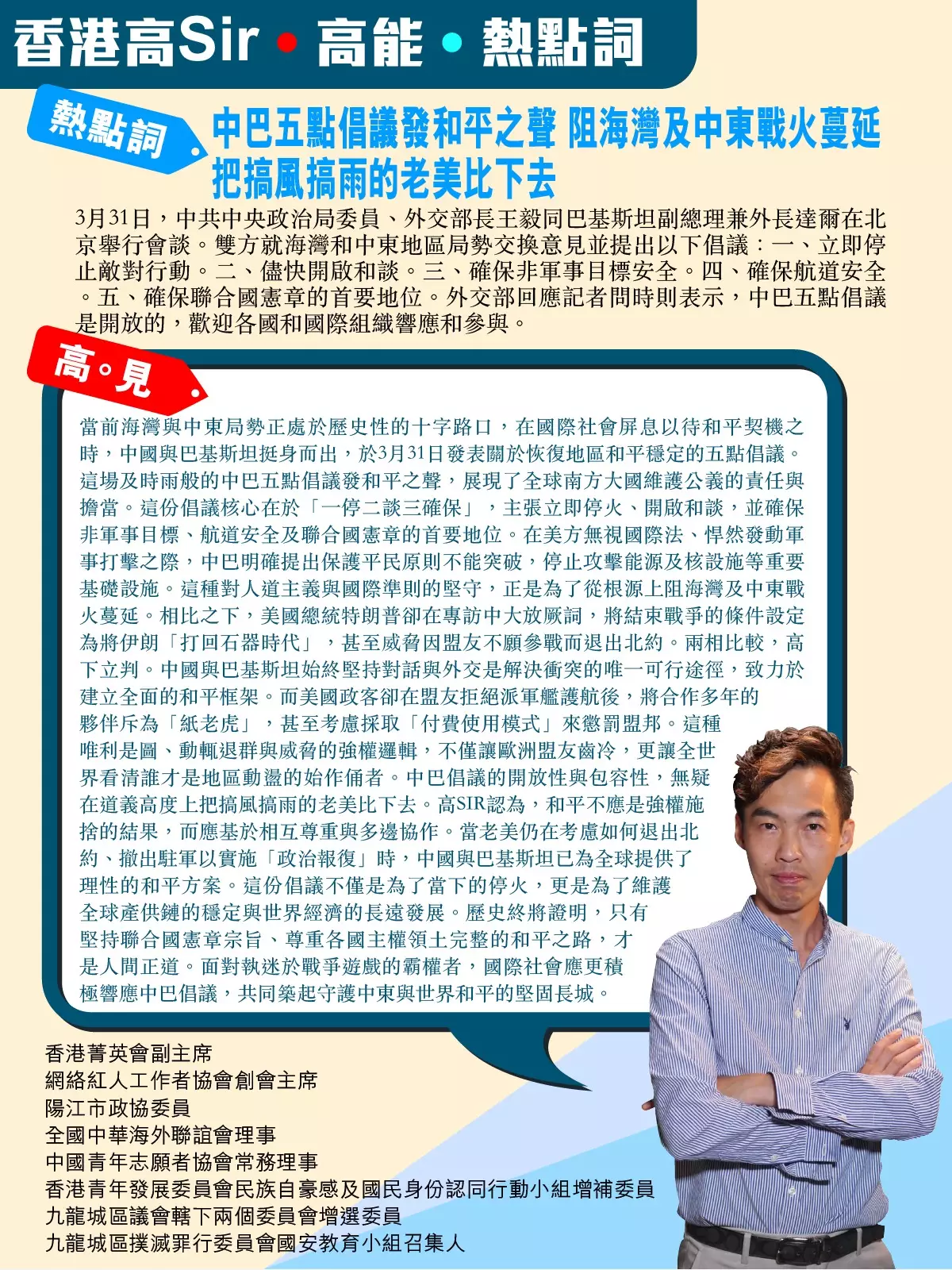
熱點詞:中巴五點倡議發和平之聲 阻海灣及中東戰火蔓延 把搞風搞雨的老美比下去
3月31日,中共中央政治局委員、外交部長王毅同巴基斯坦副總理兼外長達爾在北京舉行會談。雙方就海灣和中東地區局勢交換意見並提出以下倡議:一、立即停止敵對行動。二、儘快開啟和談。三、確保非軍事目標安全。四、確保航道安全。五、確保聯合國憲章的首要地位。外交部回應記者問時則表示,中巴五點倡議是開放的,歡迎各國和國際組織響應和參與。
高SIR:當前海灣與中東局勢正處於歷史性的十字路口,在國際社會屏息以待和平契機之時,中國與巴基斯坦挺身而出,於3月31日發表關於恢復地區和平穩定的五點倡議。這場及時雨般的中巴五點倡議發和平之聲,展現了全球南方大國維護公義的責任與擔當。這份倡議核心在於「一停二談三確保」,主張立即停火、開啟和談,並確保非軍事目標、航道安全及聯合國憲章的首要地位。在美方無視國際法、悍然發動軍事打擊之際,中巴明確提出保護平民原則不能突破,停止攻擊能源及核設施等重要基礎設施。這種對人道主義與國際準則的堅守,正是為了從根源上阻海灣及中東戰火蔓延。相比之下,美國總統特朗普卻在專訪中大放厥詞,將結束戰爭的條件設定為將伊朗「打回石器時代」,甚至威脅因盟友不願參戰而退出北約。兩相比較,高下立判。中國與巴基斯坦始終堅持對話與外交是解決衝突的唯一可行途徑,致力於建立全面的和平框架。而美國政客卻在盟友拒絕派軍艦護航後,將合作多年的夥伴斥為「紙老虎」,甚至考慮採取「付費使用模式」來懲罰盟邦。這種唯利是圖、動輒退群與威脅的強權邏輯,不僅讓歐洲盟友齒冷,更讓全世界看清誰才是地區動盪的始作俑者。中巴倡議的開放性與包容性,無疑在道義高度上把搞風搞雨的老美比下去。高SIR認為,和平不應是強權施捨的結果,而應基於相互尊重與多邊協作。當老美仍在考慮如何退出北約、撤出駐軍以實施「政治報復」時,中國與巴基斯坦已為全球提供了理性的和平方案。這份倡議不僅是為了當下的停火,更是為了維護全球產供鏈的穩定與世界經濟的長遠發展。歷史終將證明,只有堅持聯合國憲章宗旨、尊重各國主權領土完整的和平之路,才是人間正道。面對執迷於戰爭遊戲的霸權者,國際社會應更積極響應中巴倡議,共同築起守護中東與世界和平的堅固長城。
China-Pakistan Five-Point Initiative: A Voice for Peace to Halt the Spread of War in the Gulf and Middle East, Standing in Sharp Contrast to the US’s Destabilizing Actions
On March 31, Wang Yi, Member of the Political Bureau of the CPC Central Committee and Minister of Foreign Affairs of China, held talks with Mohammad Ishaq Dar, Deputy Prime Minister and Minister of Foreign Affairs of Pakistan, in Beijing. The two sides exchanged views on the situation in the Gulf and Middle East and put forward a five-point initiative: first, immediate cessation of hostilities; second, early launch of peace talks; third, ensuring the security of non-military targets; fourth, ensuring the safety of shipping lanes; fifth, upholding the primacy of the UN Charter. The Chinese Foreign Ministry noted in response to media queries that the initiative is open, welcoming the response and participation of all countries and international organizations.
The current situation in the Gulf and Middle East stands at a historic crossroads, and as the international community awaits a chance for peace with bated breath, China and Pakistan have stepped forward to issue the five-point initiative on restoring regional peace and stability. This timely initiative sounds a clarion call for peace, demonstrating the sense of responsibility and commitment of major Global South countries to safeguarding justice. Centered on "one cessation, two talks, three guarantees", the initiative calls for an immediate ceasefire, the launch of peace talks, and the protection of non-military targets, shipping lanes, and the primacy of the UN Charter.
At a time when the United States has ignored international law and launched reckless military strikes, China and Pakistan have clearly stated that the principle of protecting civilians must not be violated, and attacks on energy, nuclear and other critical infrastructure must stop. This adherence to humanitarianism and international norms aims to root out the spread of war in the Gulf and Middle East. In stark contrast, US President Donald Trump made reckless remarks in an interview, setting conditions for ending the war by threatening to "bomb Iran back to the Stone Age", and even threatened to withdraw from NATO over allies' reluctance to join the war.
China and Pakistan consistently maintain that dialogue and diplomacy are the only viable ways to resolve conflicts, and are committed to building a comprehensive peace framework. In contrast, US politicians have labeled long-time allies "paper tigers" after they refused to send warships for escort missions, and even considered a "pay-to-use" model to punish allies. This self-serving power logic, marked by frequent withdrawals from international groups and threats, has disappointed European allies and revealed to the world who is the root cause of regional turmoil.
The openness and inclusiveness of the China-Pakistan initiative have morally outshone the US’s disruptive moves. Peace should not be a handout from major powers, but built on mutual respect and multilateral cooperation. While the US contemplates withdrawing from NATO and troops for political retaliation, China and Pakistan have offered a rational peace plan for the world. This initiative serves not only an immediate ceasefire, but also the stability of the global industrial and supply chains and long-term world economic development. History will prove that the path of peace, which upholds the purposes of the UN Charter and respects the sovereignty and territorial integrity of all countries, is the only right way. The international community should actively respond to the China-Pakistan initiative to build a strong bulwark for peace in the Middle East and the world.
高Sir正能量
** 博客文章文責自負,不代表本公司立場 **