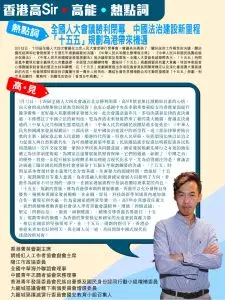

文章: 「十五五」規劃綱要全文來了,18篇62章 擘畫港澳新藍圖 一國兩制鑄就復興新旅程

3月13日,新華社受權發布《中華人民共和國國民經濟和社會發展第十五個五年規劃綱要》。此前,十四屆全國人大四次會議於3月12日表決通過有關決議,正式批準這份引領未來五年國家發展的綱領性文件。綱要合共18篇62章,覆蓋中國式現代化、新質生產力、數字中國、鄉村振興、區域協調、民生福祉、綠色發展、國家安全、國防軍隊、民主法治及一國兩制等全方位布局,構成一幅完整的強國建設與民族復興路線圖。筆者留意到,當中第十七篇「堅持和完善『一國兩制』 推進祖國統一」專章部署港澳工作,以國家頂層設計為香港、澳門長期繁榮穩定把舵定向、賦能添力。
綱要將港澳事務專列一篇、專設一章,戰略分量極重,時代意義深遠。開篇明確提出「兩個堅定不移」:堅定不移維護和促進香港、澳門長期繁榮穩定;堅定不移推進祖國統一大業,攜手共創民族復興偉業。筆者認為,這並非口號,而是十五五期間港澳工作的總綱領、總目標,向國際清晰表明:中央貫徹「一國兩制」方針絕不動搖,支持港澳繁榮發展絕不動搖,維護國家主權、安全、發展利益絕不動搖。
在治理根基上,綱要第五十九章清晰定調:堅定不移貫徹「一國兩制」、「港人治港」、「澳人治澳」、高度自治方針,落實「愛國者治港」「愛國者治澳」原則,提升港澳依法治理效能,推動經濟社會穩步向前。這一布局牢牢守住「一國」之本,充分保障「兩制」之利。唯有堅持愛國者治理,香港的法治秩序、社會穩定、營商環境才可持續鞏固,廣大市民的根本利益才能得到最穩健、最長遠的保障。
綱要以兩大重點構成港澳未來發展的清晰路徑:支持港澳鞏固提升競爭優勢,支持港澳更好融入和服務國家發展大局,一內一外、一守一進,兼顧固本強基與開拓新局。
鞏固提升競爭優勢,目的是令港澳「強筋骨、亮名片」。筆者認為對香港而言,綱要一以貫之支持鞏固提升國際金融、航運、貿易中心和國際航空樞紐地位,強化全球離岸人民幣業務樞紐、國際資產及財富管理中心、國際風險管理中心功能,構建大宗商品交易生態圈與高增值供應鏈服務中心,把傳統優勢做深做透。同時明確支持香港建設國際創新科技中心,深化國際法律及爭議解決、區域知識產權貿易、中外文化藝術交流中心建設,加快北部都會區發展,推動香港邁向金融與科創雙輪驅動、多元功能協同並進的新格局,為青年發展、產業升級、城市擴容打開更大空間。對澳門而言,綱要聚焦經濟適度多元發展,支持深化世界旅遊休閒中心、中葡商貿合作服務平台、多元文化交流合作基地建設,提升中醫藥大健康、特色金融、高新技術、會展商貿等產業競爭力,從國家戰略層面破解結構單一問題,筑牢可持續發展根基。綱要亦支持港澳打造國際高端人才集聚高地,以全球資源與人才優勢支撐長遠競爭力。
更好融入和服務國家發展大局,目的是令港澳「通血脈、拓天地」。筆者認為十五五規劃實現從「融入國家發展大局」到「更好融入和服務國家發展大局」的重要升級,標誌港澳從受益者轉為參與者、貢獻者、賦能者,形成國家支撐港澳、港澳服務國家的雙向奔赴、雙向赋能新格局。具體路徑清晰有力:深化粵港澳合作,推動港口、機場、軌道交通協同發展,建設廣州至珠海(澳門)高鐵,推進港深西部鐵路前期工作,以基礎設施硬聯通帶動要素高效流動;高質量建設前海、南沙、河套等重大合作平台,深化琴澳一體化,推進澳門國際機場橫琴前置貨站、澳琴國際教育城建設,支持澳門高校在横琴延伸辦學,以平台載體推動規則銜接、機制對接;有序推進金融市場互聯互通,深化產學研創新協同,讓香港的資金、專業服務對接內地科創與產業,培育新質生產力增長極;支持港澳深度參與高質量共建「一帶一路」,發揮專業服務優勢協助企業「走出去」,擔當中西文明交流互鑒窗口,充分釋放「背靠祖國、聯通世界」的獨特優勢。
綱要在區域協調發展篇章中,將粵港澳大灣區與京津冀、長三角一併定位為國家區域發展動力源,支持打造世界級城市群、建設國際一流灣區,強化科技創新、經濟發展、公共服務領域規則銜接與法治保障,發揮重大平台先行先試作用。筆者認為這一頂層設計是將港澳納入國家區域戰略最高層級,為香港、澳門帶來前所未有的發展空間、動能與前景。
歷史與實踐一再證明,「一國兩制」是符合國家與民族根本利益、符合港澳根本利益的好制度。「一國」是根,根深才能葉茂;「兩制」是本,本固才能枝榮。國家好,香港一定好;香港好,國家會更好。十五五規劃綱要既是國家發展藍圖,也是香港的機遇清單。
香港青年如何把握十五五新機遇
筆者認為,十五五確實為香港青年打開前所未有的機遇之門,香港青年除了要好好學習、貫徹全國兩會精彩,更應該主動對接、善用優勢、乘勢而上。一是抓緊科創與北部都會區紅利,積極投入人工智能、生命健康、數據科學、新材料等前沿領域,把握河套、新田科技城的就業與創業機會。二是善用大灣區舞台,參與港府的大灣區青年就業計劃、實習交流、創業資助,打通跨境職業路徑,在金融、法律、會計、設計、文化創意等專業領域拓展空間。三是發揮香港所長,用好國際視野、專業優勢、網絡資源,在人民幣業務、資產管理、風險管理、知識產權、中外文化交流等領域建立優勢。四是將個人理想融入國家發展,以愛國愛港為底色,在法治穩定的環境中穩步前行,在服務國家大局中實現人生價值。
青年興則香港興。十五五的黃金五年,正是香港青年奮鬥出彩的黃金期。筆者認為香港青年只要把握機遇、勇於擔當、腳踏實地,必能在國家現代化與灣區建設的浪潮中寫下屬於自己的精彩篇章。
作者簡介:高松傑,人稱高Sir,男,香港建設力量KOL、時評人,大灣區創業者、灣區推介官、2023深圳十大好網民,工商管理碩士,本科修商業、公共及社會行政,多個平台均有文章及視頻專欄,發放愛國愛港正能量,講好中國故事及香港故事
香港再出發共同發起人、香港菁英會副主席、網絡紅人工作者協會創會主席、陽江市政協委員、全國中華海外聯誼會理事、中國青年志願者協會常務理事、河南省青聯港區常委、香港青年發展委員會民族自豪感及國民身份認同行動小組增補委員、第七屆九龍城區議會轄下地區設施及工程委員會和社區參與及文化康樂委員會增選委員、九龍城區撲滅罪行委員會國安教育小組召集人、家維關愛隊成員、地區國安導師
Full Text of the 15th Five‑Year Plan Outline Released: 18 Parts & 62 Chapters Chart a New Blueprint for Hong Kong and Macao, Forging a New Journey of Rejuvenation with One Country, Two Systems
On March 13, Xinhua News Agency released the Outline of the 15th Five‑Year Plan for National Economic and Social Development of the People’s Republic of China. On March 12, the 4th Session of the 14th National People’s Congress adopted the relevant decision and formally approved this landmark document guiding China’s development over the next five years. Comprising 18 parts and 62 chapters, the Outline covers Chinese-style modernization, new quality productive forces, Digital China, rural revitalization, regional coordination, people’s well-being, green development, national security, national defense and military modernization, democracy and rule of law, and One Country, Two Systems, forming a complete roadmap for national development and national rejuvenation. Notably, Part 17: Upholding and Improving One Country, Two Systems and Advancing National Reunification is dedicated to Hong Kong and Macao affairs, providing top-level design to steer and empower the long-term prosperity and stability of the two regions.
By devoting a separate part and chapter to Hong Kong and Macao, the Outline carries extraordinary strategic weight and far-reaching significance. It clearly sets forth the Two Steadfast Resolves: to steadfastly uphold and promote the long-term prosperity and stability of Hong Kong and Macao; and to steadfastly advance the cause of national reunification, working together to create the great cause of national rejuvenation. This is no mere slogan, but the overarching guideline and goal for Hong Kong and Macao affairs in the 15th Five‑Year Plan period. It sends a clear message to the world: the central government will unwaveringly implement the principle of One Country, Two Systems, unwaveringly support the prosperity and development of Hong Kong and Macao, and unwaveringly safeguard national sovereignty, security and development interests.
On the governance foundation, Chapter 59 of the Outline sets a clear tone: to unswervingly implement the policy of One Country, Two Systems under which the people of Hong Kong administer Hong Kong, the people of Macao administer Macao, and both regions enjoy a high degree of autonomy; to implement the principles of patriots governing Hong Kong and patriots governing Macao; to enhance the law-based governance capacity of Hong Kong and Macao; and to promote steady economic and social progress. This arrangement firmly upholds the foundation of One Country and fully safeguards the benefits of Two Systems. Only by adhering to governance by patriots can Hong Kong’s rule of law, social stability and business environment be sustainably consolidated, and the fundamental interests of the general public reliably and long-term protected.
The Outline lays out a clear path for the future development of Hong Kong and Macao around two key priorities: supporting Hong Kong and Macao to consolidate and enhance their competitive edges, and supporting the two regions to better integrate into and serve the overall national development agenda. These two priorities, one internal and one external, one consolidating strengths and one forging ahead, balance foundational improvement and new breakthroughs.
Consolidating and enhancing competitive edges aims to strengthen Hong Kong and Macao and showcase their strengths. For Hong Kong, the Outline consistently supports the consolidation and enhancement of its status as an international financial, shipping and trade center and an international aviation hub. It reinforces Hong Kong’s roles as a global offshore RMB business hub, an international asset and wealth management center, and an international risk management center, and supports the development of a commodity trading ecosystem and a high value-added supply chain service center to further strengthen its traditional advantages. At the same time, it explicitly backs Hong Kong to build an international innovation and technology center, deepen its development as an international legal and dispute resolution services hub, a regional intellectual property trading center, and a center for cultural and artistic exchanges between China and the world, and accelerate the development of the Northern Metropolis. This will drive Hong Kong toward a new pattern of dual engines of finance and technology and coordinated development of multiple functions, opening up greater space for youth development, industrial upgrading and urban expansion. For Macao, the Outline focuses on appropriate economic diversification, supporting the deepening of its development as a world center of tourism and leisure, a commercial and trade cooperation service platform between China and Portuguese-speaking countries, and a base for exchanges and cooperation with Chinese culture as the mainstream and coexistence of diverse cultures. It also aims to enhance the competitiveness of Macao’s industries such as traditional Chinese medicine and healthcare, characteristic finance, high technology, and exhibitions and trade, addressing the challenge of economic structural imbalance at the national strategic level and laying a solid foundation for sustainable development. The Outline also supports Hong Kong and Macao in building highland for attracting international high-end talents, leveraging global resources and talent to underpin long-term competitiveness.
Better integrating into and serving the overall national development agenda aims to connect Hong Kong and Macao to the national bloodstream and expand their horizons. A major upgrade in the 15th Five‑Year Plan is the shift from “integrating into the national development agenda” to “better integrating into and serving the overall national development agenda”. This change marks a transition for Hong Kong and Macao from beneficiaries to participants, contributors and enablers, forming a new pattern of mutual empowerment and shared progress between the country supporting Hong Kong and Macao and the two regions serving the country. The concrete pathways are clear and robust: deepening Guangdong-Hong Kong-Macao cooperation, promoting coordinated development of ports, airports and rail transit, advancing the construction of the Guangzhou-Zhuhai (Macao) high-speed rail and the preliminary work of the Hong Kong-Shenzhen Western Railway, using hard infrastructure connectivity to facilitate efficient flows of factors; developing major cooperation platforms including Qianhai, Nansha and Hetao with high standards, deepening the integrated development of Hengqin and Macao, advancing the construction of the Macao International Airport Hengqin Pre-check Cargo Terminal and the Macao-Hengqin International Education City (University Town), and supporting Macao universities to extend their operations in Hengqin, using platform carriers to advance regulatory alignment and institutional connection; orderly promoting the interconnection of financial markets with the mainland and deepening industry-university-research innovation collaboration, matching Hong Kong’s capital and professional services with mainland technology and industries to foster new growth poles of new quality productive forces; and supporting Hong Kong and Macao to take an in-depth part in the high-quality development of the Belt and Road Initiative, leveraging their professional service strengths to help mainland enterprises go global, and serving as a window for exchanges and mutual learning between Chinese and Western civilizations, fully unlocking their unique advantage of enjoying strong support from the motherland and global connectivity.
In the chapter on coordinated regional development, the Outline positions the Guangdong-Hong Kong-Macao Greater Bay Area (GBA) alongside the Beijing-Tianjin-Hebei region and the Yangtze River Delta as growth engines of national regional development. It supports their development into world-class city clusters and international first-class bay areas, strengthens regulatory alignment and institutional connection in technological innovation, economic development and public services, enhances legal safeguards, and gives full play to the pilot role of major cooperation platforms. This top-level design integrates Hong Kong and Macao into the highest tier of national regional strategies, bringing unprecedented development space, momentum and prospects for the two regions.
History and practice have repeatedly proven that One Country, Two Systems is a sound system that serves the fundamental interests of the country, the nation, and Hong Kong and Macao. One Country is the root; only when the root is deep can the leaves flourish. Two Systems is the foundation; only when the foundation is solid can the branches thrive. When the country prospers, Hong Kong will surely thrive; when Hong Kong prospers, the country will prosper even more. The 15th Five‑Year Plan Outline is not only a blueprint for national development but also a checklist of opportunities for Hong Kong.
How Hong Kong Youth Can Seize the Opportunities of the 15th Five‑Year Plan
The 15th Five‑Year Plan has opened an unprecedented window of opportunity for Hong Kong youth. Beyond studying and understanding the outcomes of the Two Sessions, young people in Hong Kong should proactively align themselves with national strategies, leverage their strengths and ride the momentum. First, seize the dividends of technological innovation and the Northern Metropolis, actively engage in cutting-edge fields such as artificial intelligence, life and health, data science and new materials, and capitalize on employment and entrepreneurship opportunities in the Hetao and San Tin Technopoles. Second, make full use of the GBA platform, participate in the Hong Kong SAR Government’s GBA Youth Employment Scheme, internship and exchange programs, and entrepreneurship support schemes, open up cross-border career paths, and expand horizons in professional fields including finance, law, accounting, design and cultural and creative industries. Third, leverage Hong Kong’s unique strengths, use international vision, professional expertise and global networks to build competitive edges in RMB business, asset management, risk management, intellectual property and cultural exchanges between China and the world. Fourth, integrate personal aspirations into national development, take pride in patriotism and love for Hong Kong, forge ahead in a stable and law-based environment, and realize personal value while serving the national agenda.
A thriving youth means a thriving Hong Kong. The golden five years of the 15th Five‑Year Plan are a prime time for Hong Kong youth to strive for excellence. By seizing opportunities, daring to take on responsibilities and staying grounded, Hong Kong youth will surely write their own brilliant chapters in the tide of national modernization and the development of the Greater Bay Area.
Jacky Chung Kit Ko (HK Ko Sir)
高Sir正能量
** 博客文章文責自負,不代表本公司立場 **